Đề kiểm tra học kì I môn Tiếng Anh Lớp 12 - Mã đề 000 - Năm học 2023-2024 - Trường THPT Phan Châu Trinh (Có đáp án)
 4 Trang
25
4 Trang
25
Bạn đang xem tài liệu "Đề kiểm tra học kì I môn Tiếng Anh Lớp 12 - Mã đề 000 - Năm học 2023-2024 - Trường THPT Phan Châu Trinh (Có đáp án)", để tải tài liệu gốc về máy hãy click vào nút Download ở trên.
Tóm tắt nội dung tài liệu: Đề kiểm tra học kì I môn Tiếng Anh Lớp 12 - Mã đề 000 - Năm học 2023-2024 - Trường THPT Phan Châu Trinh (Có đáp án)
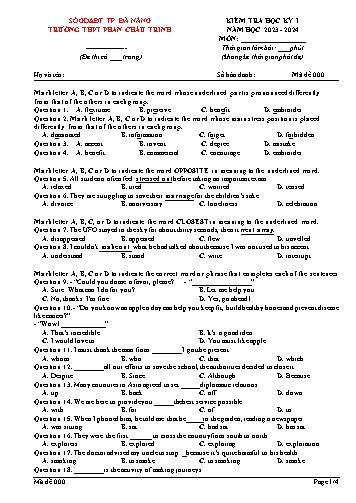
 SỞ GD&ĐT TP. ĐÀ NẴNG KIỂM TRA HỌC KỲ I
 TRƯỜNG THPT PHAN CHÂU TRINH NĂM HỌC 2023 - 2024
 MÔN: __________________
 -------------------- Thời gian làm bài: ___ phút
 (Đề thi có ___ trang) (không kể thời gian phát đề)
Họ và tên: ............................................................................ Số báo danh: ....... Mã đề 000
Mark letter A, B, C or D to indicate the word whose underlined part is pronounced differently
from that of the others in each group.
Question 1. A. flexitime B. preserve C. benefit D. embroider
Question 2. Mark letter A, B, C or D to indicate the word whose main stress position is placed
differently from that of the others in each group.
 A. dominated B. information C. forget D. forbidden
Question 3. A. accent B. invent C. degree D. mistake
Question 4. A. benefit B. commercial C. encourage D. embroider
Mark letter A, B, C or D to indicate the word OPPOSITE in meaning to the underlined word.
Question 5. All students often feel stressed out before taking an important exam.
 A. relaxed B. tired C. worried D. tensed
Question 6. They are struggling to save their marriage for the children’s sake.
 A. divorce B. anniversary C. loneliness D. celebration
Mark letter A, B, C, or D to indicate the word CLOSEST in meaning to the underlined word.
Question 7. The UFO stayed in the sky for about thirty seconds, then it went away.
 A. disappeared B. appeared C. flew D. travelled
Question 8. I couldn't make out what he had talked about because I was not used to his accent.
 A. understand B. stand C. write D. interrupt
Mark letter A, B, C or D to indicate the correct word or phrase that completes each of the sentences
Question 9. - “Could you do me a favor, please? - “________________”
 A. Sure. What can I do for you? B. Let me help you.
 C. No, thanks. I’m fine. D. Yes, go ahead!
Question 10. - “Do you know an apple a day can help you keep fit, build healthy bones and prevent disease
like cancer?”
- “Wow! ____________”
 A. That’s incredible. B. It’s a good idea.
 C. I would love to. D. You must like apple.
Question 11. I must thank the man from ________ I got the present.
 A. whom B. who C. that D. which
Question 12. ________ all our efforts to save the school, the authorities decided to close it.
 A. Despite B. Since C. Although D. Because
Question 13. Many countries in Asia agreed to set _____ diplomatic relations.
 A. up B. back C. off D. down
Question 14. We are here to provide you _____the best service possible
 A. with B. for C. of D. to
Question 15. When I phoned him, he told me that he in the garden, reading a newspaper.
 A. was sitting B. sat C. had sat D. has sat
Question 16. They were the first ______ to cross the country from south to north.
 A. explorers B. explored C. exploring D. exploration
Question 17. The doctor advised my uncle to stop because it’s quite harmful to his health.
 A. smoking B. to smoke C. to smoking D. smoke
Question 18. ________ is the activity of making journeys.
Mã đề 000 Page 1/4 A. Travelling B. Sunbathing C. Sightseeing D. Wandering
Question 19. We are looking for someone who is ________ and hard-working.
 A. reliable B. lacked C. hopeful D. smooth
Question 20. My sister, Tuyet, was ______ when she won the scholarship.
 A. over the moon B. once in a blue moon
 C. out of this world D. many moons ago
Mark the letter A, B, C or D on your answer sheet to indicate the underlined part that needs correction
in each of the following questions.
Question 21. Mumps are a very common disease which usually affects children.
 A. are B. usually C. common disease D. which
Question 22. Children who’s parents spend time with them and take an interest in their education tend to
do better in school.
 A. who’s B. with them C. an interest D. to do
Read the following passage and mark the letter A, B, C or D to indicate the correct word that
complete each of the blanks.
During the war, children wore straw hats to (23) themselves from debris. Houses and schools
were bombed and destroyed. Many children were made (24) and their schools had to be
moved around or lessons sometimes had to (25) after dark to avoid being targeted by heavy
bombing. Many schools had its roof covered with several (26) of straw to withstand the impacts
of the bombs. Life for children was very hard in both the North and South of Viet Nam during the war.
Young people were (27) of their duty to serve their country. Even young girls took part in
the war efforts by digging bomb shelters. Children took first-aid courses after school so that they could
care for injured people.
Childhood years of children born in the 1960s are unforgettable. As innocent children, they went to school
wearing straw hats in the sounds of American jet fighters in the sky and the shots from Vietnamese anti-
aircraft guns.
Question 23. A. save B. keep C. protect D. help
Question 24. A. homemade B. homeless C. homelessness D. homesick
Question 25. A. place B. take place C. be happened D. exist
Question 26. A. classes B. layer C. layers D. class
Question 27. A. known B. afraid C. capable D. aware
Read the following passage and mark the letter A, B, C or D to indicate the correct answer to each of
the questions that follow.
Many people now think that teachers give pupils too much homework. They say that it is unnecessary for
children to work at home in their free time. Moreover, they argue that most teachers do not properly plan
the homework tasks they give to pupils. The result is that pupils have to repeat tasks which they have
already done at school.
Recently in Greece many parents complained about the difficult homework which teachers gave to their
children. The parents said that most of the homework was a waste of time, and they wanted to stop it. Spain
and Turkey are two countries which stopped homework recently. In Denmark, West Germany and several
other countries in Europe, teachers cannot set homework at weekends. In Holland, teachers allow pupils to
stay at school to do their homework. The children are free to help one another. Similar arrangements also
exist in some British schools.
Most people agree that homework is unfair. A pupil who can do his homework in a quiet and comfortable
room is in a much better position than a pupil who does his homework in a small, noisy room with the
television on. Some parents help their children with their homework. Other parents take no interest at all in
their children’s homework. It is important, however, that teachers talk to parents about homework. A
teacher should suggest suitable tasks for parents to do with their children. Parents are often better at teaching
their own children.
Mã đề 000 Page 2/4 Question 28. This passage mainly discusses ______.
 A. the way people see and deal with students’ homework
 B. parents’ role in assisting their children with homework
 C. doing too difficult homework
 D. the importance of homework in students’ life
 Question 29. The word ‘properly’ can best be replaced with _____.
 A. suitably B. accurately C. beautifully D. successfully
 Question 30. Greek parents thought ______.
 A. their children’s homework was too hard.
 B. their children’s homework was too easy.
 C. their children’s homework was too useful.
 D. more time should be allowed for homework.
 Question 31. In some countries in Europe, ______.
 A. teachers cannot have their pupils do homework at weekends
 B. few people think homework is unfair
 C. teachers are allowed to give homework to children only at weekends
 D. most people agree that it is fair to have children do homework at home
 Question 32. The following statements are true EXCEPT ______
 A. All parents show great interest in their children’s homework.
 B. Children can do their homework at school and help one another in some schools in Britain.
 C. Only a small number of people think homework is fair.
 D. Teachers should advise parents about how to work together with their children at home.
 Mark letter A, B, C or D on your answer sheet to indicate the sentence that is closest in meaning to
 the original sentence in each of the following questions.
 Question 33. Her father invited him to the conference.
 A. He was invited to the conference by her father.
 B. He is invited to the conference by her father.
 C. He has been invited to the conference by her father.
 D. He were invited to the conference by her father.
 Question 34. Although the weather was bad, the farmers kept on working in the fields.
 A. In spite of the bad weather, the farmers kept on working in the fields.
 B. Despite the weather was bad, the farmers kept on working in the fields.
 C. In spite of the bad weather, but the farmers kept on working in the fields.
 D. Because of the bad weather, the farmers kept on working in the fields.
Question 35. Jane is busy, so she can’t meet you now
 A. Unless Jane were busy, she could meet you now
 B. If Jane isn’t busy, she can meet you now.
 C. If Jane were busy, she couldn’t meet you now
 D. Unless Jane is busy, she can’t meet you
 Question 36. “Please do not litter as you are walking along the coast”, the guard said to us.
 A. The guard told us not to litter as we were walking along the coast.
 B. The guard told us to litter as we were walking along the coast.
 C. The guard told us do not to litter as we were walking along the coast.
 D. The guard told us did not to litter as we were walking along the coast.
 Mark the letter A, B, C or D to indicate the sentence that is BEST written from the words/ phrases
 given.
 Question 37. I/used/go/cinema/Sundays.
 A. I used to go to the cinema on Sundays.
 B. I usually go to the cinema on Sundays.
 C. I got used to going the cinema on Sundays.
 Mã đề 000 Page 3/4 D. I used to went to the cinema on Sundays.
Question 38. Jim/wish/parents/not/expect/too/much/him.
 A. Jim wishes his parents did not expect too much from him.
 B. Jim wishs his parents expected much from him.
 C. Jim wish his parents did not expect too much from him.
 D. Jim wishes my parents did not expect too much from him.
Question 39. No/country/Asia/as/large/China.
 A. No other country in the Asia is as large as China.
 B. No other country in the Asia is as large than China.
 C. Any other country in the Asia is larger than China.
 D. China is as large as other countries in the Asia.
Question 40. Nam/won/scholarship/studied/well.
 A. Nam, who studied well, won the scholarship.
 B. Nam, that studied well, won the scholarship.
 C. Nam who studied well, won the scholarship.
 D. Nam won the scholarship, so he studied well.
 ------ THE END ------
Mã đề 000 Page 4/4
File đính kèm:
- de_kiem_tra_hoc_ki_i_mon_tieng_anh_lop_12_ma_de_000_nam_hoc.docx
 Dap_an_excel_app_QM(12).xlsx