Đề minh họa tốt nghiệp THPT Tiếng Anh - Đề 10 (Có đáp án)
 7 Trang
54
7 Trang
54
Bạn đang xem tài liệu "Đề minh họa tốt nghiệp THPT Tiếng Anh - Đề 10 (Có đáp án)", để tải tài liệu gốc về máy hãy click vào nút Download ở trên.
Tóm tắt nội dung tài liệu: Đề minh họa tốt nghiệp THPT Tiếng Anh - Đề 10 (Có đáp án)
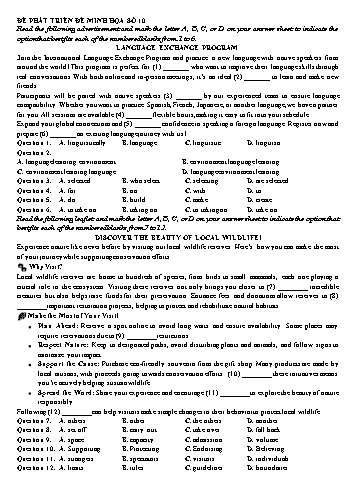
ĐỀ PHÁT TRIỂN ĐỀ MINH HỌA SỐ 10 Read the following advertisement and mark the letter A, B, C, or D on your answer sheet to indicate the option that best fits each of the numbered blanks from 1 to 6. LANGUAGE EXCHANGE PROGRAM Join the International Language Exchange Program and practice a new language with native speakers from around the world! This program is perfect for (1) _______ who want to improve their language skills through real conversations. With both online and in-person meetings, it’s an ideal (2) _______ to learn and make new friends. Participants will be paired with native speakers (3) _______ by our experienced team to ensure language compatibility. Whether you want to practice Spanish, French, Japanese, or another language, we have a partner for you. All sessions are available (4) _______ flexible hours, making it easy to fit into your schedule. Expand your global connections and (5) _______ confidence in speaking a foreign language. Register now and prepare (6) _______ an exciting language journey with us! Question 1. A. linguistically B. language C. linguistic D. linguists Question 2. A. language learning environment B. environment language learning C. environment learning language D. language environment learning Question 3. A. selected B. who select C. selecting D. are selected Question 4. A. for B. on C. with D. to Question 5. A. do B. build C. make D. create Question 6. A. to take on B. taking on C. to taking on D. take on Read the following leaflet and mark the letter A, B, C, or D on your answer sheet to indicate the option that best fits each of the numbered blanks from 7 to 12. DISCOVER THE BEAUTY OF LOCAL WILDLIFE! Experience nature like never before by visiting our local wildlife reserves. Here’s how you can make the most of your journey while supporting conservation efforts. Why Visit? Local wildlife reserves are home to hundreds of species, from birds to small mammals, each one playing a crucial role in the ecosystem. Visiting these reserves not only brings you closer to (7) ________ incredible creatures but also helps raise funds for their preservation. Entrance fees and donations allow reserves to (8) ________ important restoration projects, helping to protect and rehabilitate natural habitats. Make the Most of Your Visit! ● Plan Ahead: Reserve a spot online to avoid long waits and ensure availability. Some places may require reservations due to (9) ________ restrictions. ● Respect Nature: Keep to designated paths, avoid disturbing plants and animals, and follow signs to minimize your impact. ● Support the Cause: Purchase eco-friendly souvenirs from the gift shop. Many products are made by local artisans, with proceeds going towards conservation efforts. (10) ________ these initiatives means you’re actively helping sustain wildlife. ● Spread the Word: Share your experience and encourage (11) ________ to explore the beauty of nature responsibly. Following (12) ________ can help visitors make simple changes in their behavior to protect local wildlife. Question 7. A. others B. other C. the others D. another Question 8. A. set off B. carry out C. take over D. fall back Question 9. A. space B. capacity C. admission D. volume Question 10. A. Supporting B. Protecting C. Endorsing D. Believing Question 11. A. strangers B. spectators C. visitors D. individuals Question 12. A. limits B. rules C. guidelines D. boundaries Mark the letter A, B, C, or D on your answer sheet to indicate the best arrangement of utterances or sentences to make a meaningful exchange or text in each of the following questions from 13 to 17. Question 13. a. Anna: I can’t believe how much the story changed throughout the book. What did you think of the ending? b. Mark: I just finished reading that fascinating novel last night, and it left me with so many thoughts. c. Anna: I found the ending quite surprising, especially with that twist involving the main character. A. c – b – a B. b – a – c C. c – a – a D. a – b – c Question 14. a. Anna: Well, it’s a very healthy choice and quite easy to make at home, so it’s convenient. b. Sarah: I’m not really sure, but I just want something that’s simple and quick for lunch. c. Anna: How about we have a salad for lunch? It’s light and refreshing. d. Sarah: That sounds perfect to me! Thanks for the suggestion. I’ll definitely go with that. e. Anna: Why don’t you try a quick salad? It’s easy to prepare and tastes great too. A. b – a – d – c – e B. c – e – a – b – d C. c – e – a – d – b D. e – b – a – c – d Question 15. Hi Tim, a. I hope you’re as excited as I am for this amazing night ahead! b. I just booked our tickets for the concert next Saturday – it’s going to be a blast. c. I can’t believe the day is coming up so soon, and we’re finally going to see them live! d. Get ready for what will definitely be an unforgettable night filled with awesome music and great vibes. e. Don’t forget to bring your ID for entry; they’re being quite strict with the rules this year. Looking forward to it, Jess A. b – d – a – c – e B. a – b – c – e – d C. d – c – a – b – e D. e – b – d – c – a Question 16. a. People are finding creative ways to reduce waste, conserve energy, and cut down on single-use products, all in an effort to lead more sustainable lives. b. Schools and universities around the world are actively teaching students about the importance of protecting our planet and fostering a sustainable future. c. Recycling has also become a common practice in households, as families make conscious efforts to reduce their carbon footprint and waste. d. In addition, local governments and organizations are encouraging conservation efforts, such as community clean-ups and green policies, to improve urban environments. e. This collective focus on sustainability has led to positive changes worldwide, helping the environment and inspiring future generations. A. a – e – b – c – d B. c – d – a – e – b C. e – c – b – d – a D. a – b – c – d – e Question 17. a. Artificial intelligence (AI) is transforming various industries, from healthcare to finance, by automating processes and improving efficiency in ways previously unimaginable. b. AI technologies are now being used to diagnose diseases accurately, manage complex datasets, and even make predictive analyses in fields like epidemiology and economics. c. Furthermore, advanced AI systems help automate repetitive tasks, which can save time, reduce costs, and allow human employees to focus on more creative and strategic work. d. As the field of AI continues to advance, the role it plays in our lives will undoubtedly grow, impacting both personal and professional domains. e. As a result, the demand for skilled AI professionals who can develop, maintain, and regulate these technologies is on the rise across industries. A. a – b – c – e – d B. d – a – c – b – e C. a – c – e – b – d D. e – d – b – a – c Read the following passage and mark the letter A, B, C, or D on your answer sheet to indicate the option that best fits each of the numbered blanks from 18 to 22. THE ROLE OF TECHNOLOGY IN MODERN EDUCATION Technology has transformed modern education in significant ways. Today, classrooms are no longer restricted to physical spaces, as students and teachers (18) _______. Online platforms and virtual classrooms allow for a more flexible and accessible learning environment, providing education to students across the globe. In recent years, educational institutions have increasingly relied on digital tools, (19) _______. These tools not only facilitate teaching but also help in managing academic records and tracking student progress. With the rise of online learning, the traditional role of the teacher has also evolved, focusing more on guidance and mentorship rather than merely delivering information. One notable benefit of technology in education is its ability to offer personalized learning experiences, (20) _______. Each student can now receive material tailored to their own pace and learning style, thus enhancing their understanding and retention. Despite the advantages, there are challenges, as not all students have equal access to these technological resources. Ensuring fair access to technology is crucial for bridging the educational divide and (21) _______. Overall, technology continues to shape the educational landscape, making learning more interactive, engaging, and inclusive. The future of education is likely to see even more innovations as (22) _______. Question 18. A. were given access to online learning tools, which increased participation and flexibility across the world B. who had access to online resources gained more flexibility in managing their learning activities C. having been actively encouraged to participate in digital classrooms, enhancing their learning experiences D. who had digital access got to interact more flexibly with educational resources provided through virtual platforms Question 19. A. which help to streamline administrative tasks, reduce paperwork, and improve communication within the school B. facilitate classroom activities while tracking and reporting student progress more accurately C. which are beneficial in supporting teachers and students, helping create engaging and effective learning environments D. help in developing, monitoring, and delivering educational content and enhancing student engagement Question 20. A. with customized resources to enhance learning outcomes, students can experience better comprehension and engagement B. by gaining access to relevant content, students receive a more customized and focused educational experience C. providing tailored materials for students allows them to learn at a pace suited to their preferences and ability levels D. having highly relevant content available allows each student to make the most of their learning environment Question 21. A. leveling the playing field so all students can benefit equally from digital resources in their education B. providing equal opportunities for education, which in turn supports academic success and student satisfaction C. creating a universal standard that allows every student to have identical learning experiences D. reducing the gap in access to resources, helping all students compete equally in a global environment Question 22. A. technology evolves, enabling continuous improvements in interactive, dynamic learning environments worldwide B. more schools implement the latest digital trends to keep up with educational advancements and changing needs C. the demand for technological resources in education increases, aiming to meet the needs of modern students D. institutions invest in future-ready solutions that transform both student engagement and academic outcomes Read the following passage and mark the letter A, B, C or D on your answer sheet to indicate the best answer to each of the following questions from 23 to 30. Ecotourism is a form of tourism that emphasizes conservation, responsible travel, and the well-being of local communities. It aims to minimize the environmental impact of tourism and promote awareness of conservation efforts. Ecotourism has become particularly popular in biodiversity-rich areas, where it offers an alternative to traditional tourism, which can harm the environment and disrupt local ecosystems. One of the main benefits of ecotourism is that it provides an economic incentive for conservation. Local communities that rely on tourism for income are more likely to protect their natural resources. Instead of engaging in activities like deforestation or hunting endangered animals, they can benefit from preserving the environment. This helps to ensure that local wildlife and habitats are protected for future generations. However, ecotourism also has its drawbacks. Increased human activity in natural areas, even if well- intentioned, can disturb wildlife and lead to environmental degradation. Tourists may leave behind waste or introduce non-native species that threaten local ecosystems. Additionally, ecotourism projects can sometimes prioritize tourist experience over genuine conservation efforts, leading to "greenwashing," where businesses promote themselves as eco-friendly without actually supporting sustainable practices. For ecotourism to be effective, it must be well-regulated and based on sound environmental principles. This includes limiting the number of visitors to sensitive areas, educating tourists about respectful behavior, and ensuring that a significant portion of profits is reinvested in conservation projects. When managed responsibly, ecotourism can provide a sustainable way to appreciate and protect the natural world. Question 23. Which of the following is NOT a goal of ecotourism? A. Increasing tourist numbers B. Supporting local communities C. Minimizing environmental impact D. Promoting conservation Question 24. The word "incentive" in paragraph 2 is CLOSEST in meaning to _______. A. consequence B. benefit C. reason D. requirement Question 25. The word "disturb" in paragraph 3 is OPPOSITE in meaning to _______. A. comfort B. protect C. agitate D. exploit Question 26. The word "they" in paragraph 2 refers to _______. A. tourists B. local communities C. ecotourism activities D. conservation efforts Question 27. Which of the following best paraphrases the underlined sentence in paragraph 3? A. Ecotourism has a positive impact on the environment. B. Ecotourism can be harmful if not managed well. C. Ecotourism focuses on preserving ecosystems. D. Ecotourism is always beneficial for the environment. Question 28. According to the passage, which of the following is TRUE? A. Ecotourism eliminates the need for conservation efforts. B. Unregulated ecotourism can damage local environments. C. All ecotourism projects are highly profitable. D. Tourism and conservation are always in conflict. Question 29. In which paragraph does the writer discuss economic benefits of ecotourism? A. Paragraph 1 B. Paragraph 2 C. Paragraph 3 D. Paragraph 4 Question 30. In which paragraph does the writer discuss potential negative effects of ecotourism? A. Paragraph 1 B. Paragraph 2 C. Paragraph 3 D. Paragraph 4 Read the following passage and mark the letter A, B, C or D on your answer sheet to indicate the best answer to each of the following questions from 31 to 40. Graduation is often seen as a significant milestone in a person’s life, marking the end of formal education and the beginning of a new chapter. The saying “the world is your oyster” encapsulates the limitless opportunities that graduates may encounter as they embark on their professional journeys. [I] However, the transition from academia to the workforce can be daunting for many, as they must navigate the complexities of career choices and job searching. [II] One of the primary challenges graduates face is the pressure to choose a career path that aligns with their interests and skills while also ensuring financial stability. [III] Many graduates feel overwhelmed by the myriad of options available, leading to a phenomenon known as “analysis paralysis.” As they weigh their options, some may struggle to make a decision, fearing that they will make the wrong choice. Moreover, external pressures from family and societal expectations can further complicate this decision-making process. To ease this , graduates are encouraged to engage in internships or volunteer work related to their fields of interest. [IV] Gaining practical experience can provide invaluable insights into different professions and help individuals make more informed career choices. Networking with professionals in their desired fields can also offer guidance and open doors to potential job opportunities. Ultimately, while the transition from graduation to a career can be challenging, it is also an exciting time filled with possibilities. By embracing the journey and being open to exploring various paths, graduates can carve out fulfilling careers that resonate with their aspirations and values. Question 31. Where in the passage does the following sentence best fit? This period is often filled with both excitement and uncertainty. A. [I] B. [II] C. [III] D. [IV] Question 32. The idiom “the world is your oyster” in paragraph 1 could be best replaced by _______. A. opportunities are scarce B. the future is uncertain C. there are endless possibilities D. choices are limited Question 33. The word “this” in paragraph 2 refers to _______. A. the transition B. a career path C. job searching D. graduation Question 34. According to paragraph 2, which of the following is NOT a challenge graduates face? A. External pressures from family B. Analysis paralysis C. Difficulty finding internships D. Aligning interests with career stability Question 35. Which of the following best summarises paragraph 3? A. Practical experience is irrelevant to career decision-making. B. Networking is not essential for job searching. C. Engaging in internships can help clarify career paths. D. Graduates should only rely on academic qualifications. Question 36. The word “complicate” in paragraph 2 is OPPOSITE in meaning to _______. A. simplify B. confuse C. hinder D. enhance Question 37. Which of the following is TRUE according to the passage? A. All graduates know exactly what career they want to pursue. B. Practical experience can lead to better career choices. C. Family expectations have no impact on career decisions. D. Graduating always guarantees immediate job placement. Question 38. Which of the following best paraphrases the underlined sentence in paragraph 4? A. Graduates should ignore their interests and focus solely on financial gain. B. The transition to a career is filled with both challenges and exciting opportunities. C. It’s essential to follow a strict career path after graduation. D. Graduates must be cautious and avoid any risks in their careers. Question 39. Which of the following can be inferred from the passage? A. Graduates often regret their career choices immediately after graduation. B. Exploring different career paths can help alleviate uncertainty. C. Networking is only beneficial for certain professions. D. Financial stability is the most important factor for all graduates. Question 40. Which of the following best summarises the passage? A. Graduation marks a critical transition that can be both overwhelming and full of opportunities, requiring careful consideration of career choices. B. The pressures of job searching make it difficult for graduates to enjoy their new freedom. C. Practical experience is not essential for choosing a career path. D. Graduates should ignore external influences and focus on personal aspirations. --------------------- THE END --------------------- - Thí sinh không sử dụng tài liệu. - Giám thị coi thi không giải thích gì thêm. 1 D 2 A 3 A 4 A 5 B 6 A 7 B 8 B 9 B 10 A 11 C 12 C 13 D 14 B 15 A 16 D 17 A 18 A 19 A 20 C 21 A 22 A 23 A 24 C 25 B 26 B 27 B 28 B 29 B 30 C 31 A 32 C 33 A 34 C 35 C 36 A 37 B 38 B 39 B 40 A
File đính kèm:
- de_minh_hoa_tot_nghiep_thpt_tieng_anh_de_10_co_dap_an.doc