Đề minh họa tốt nghiệp THPT Tiếng Anh - Đề 11 (Có đáp án)
 6 Trang
56
6 Trang
56
Bạn đang xem tài liệu "Đề minh họa tốt nghiệp THPT Tiếng Anh - Đề 11 (Có đáp án)", để tải tài liệu gốc về máy hãy click vào nút Download ở trên.
Tóm tắt nội dung tài liệu: Đề minh họa tốt nghiệp THPT Tiếng Anh - Đề 11 (Có đáp án)
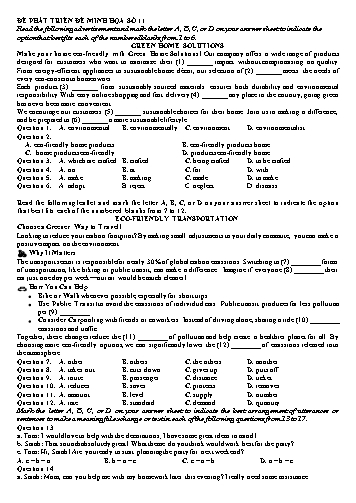
ĐỀ PHÁT TRIỂN ĐỀ MINH HỌA SỐ 11 Read the following advertisement and mark the letter A, B, C, or D on your answer sheet to indicate the option that best fits each of the numbered blanks from 1 to 6. GREEN HOME SOLUTIONS Make your home eco-friendly with Green Home Solutions! Our company offers a wide range of products designed for customers who want to minimize their (1) _______ impact without compromising on quality. From energy-efficient appliances to sustainable home décor, our selection of (2) _______ meets the needs of every eco-conscious homeowner. Each product (3) _______ from sustainably sourced materials ensures both durability and environmental responsibility. With easy online shopping and fast delivery (4) _______ any place in the country, going green has never been more convenient. We encourage our customers (5) _______ sustainable choices for their home. Join us in making a difference, and be prepared to (6) _______ a more sustainable lifestyle. Question 1. A. environmental B. environmentally C. environment D. environmentalist Question 2. A. eco-friendly home products B. eco-friendly products home C. home products eco-friendly D. products eco-friendly home Question 3. A. which are crafted B. crafted C. being crafted D. to be crafted Question 4. A. on B. at C. for D. with Question 5. A. make B. making C. made D. to make Question 6. A. adopt B. reject C. neglect D. dismiss Read the following leaflet and mark the letter A, B, C, or D on your answer sheet to indicate the option that best fits each of the numbered blanks from 7 to 12. ECO-FRIENDLY TRANSPORTATION Choose a Greener Way to Travel! Looking to reduce your carbon footprint? By making small adjustments to your daily commute, you can make a positive impact on the environment. Why It Matters The transport sector is responsible for nearly 30% of global carbon emissions. Switching to (7) ________ forms of transportation, like biking or public transit, can make a difference. Imagine if everyone (8) ________ their car just one day per week—our air would be much cleaner! How You Can Help ● Bike or Walk whenever possible, especially for short trips. ● Use Public Transit to avoid the emissions of individual cars. Public transit produces far less pollution per (9) ________. ● Consider Carpooling with friends or coworkers. Instead of driving alone, sharing a ride (10) ________ emissions and traffic. Together, these changes reduce the (11) ________ of pollution and help create a healthier planet for all. By choosing more eco-friendly options, we can significantly lower the (12) ________ of emissions released into the atmosphere. Question 7. A. other B. others C. the others D. another Question 8. A. takes out B. cuts down C. gives up D. puts off Question 9. A. route B. passenger C. distance D. ticket Question 10. A. reduces B. saves C. protects D. removes Question 11. A. amount B. level C. supply D. number Question 12. A. rate B. standard C. demand D. quantity Mark the letter A, B, C, or D on your answer sheet to indicate the best arrangement of utterances or sentences to make a meaningful exchange or text in each of the following questions from 13 to 17. Question 13 a. Tom: I would love to help with the decorations; I have some great ideas in mind! b. Sarah: That sounds absolutely great! What theme do you think would work best for the party? c. Tom: Hi, Sarah! Are you ready to start planning the party for next weekend? A. c – b – a B. b – a – c C. c – a – b D. a – b – c Question 14 a. Sarah: Mom, can you help me with my homework later this evening? I really need some assistance. b. Mom: Of course, sweetheart! What specific part of your homework do you need help with? c. Sarah: I have to write an essay about our family history, and I want to make sure I get it just right. d. Mom: That sounds like a fascinating topic! I can share some interesting stories from when I was younger that might inspire you. e. Sarah: Thanks so much, Mom! I really appreciate your support and guidance with this. A. a – b – c – d – e B. c – a – b – d – e C. a – c – e – d – b D. b – c – a – d – e Question 15 a. It’s truly remarkable to see the intricate designs and towering structures up close. b. I had the chance to visit the ancient temples yesterday, and it was incredible. c. You would absolutely love to witness the beauty and history for yourself. d. The detailed carvings on the walls are unbelievably intricate and breathtaking. e. The guide was also really informative and explained the historical significance of each structure we visited. A. b – e – d – a – c B. c – b – a – e – d C. e – b – c – d – a D. d – a – c – b – e Question 16 a. Getting enough sleep is crucial for maintaining mental health, improving memory, and supporting physical recovery after daily activities. b. People who are well-rested tend to be more productive, have better moods, and show higher levels of concentration and creativity. c. Sleep allows the body to repair itself and process information, both of which are essential for maintaining mental and physical health. d. Lack of sufficient sleep can lead to various health issues, including weight gain, reduced immune function, and increased risk of chronic diseases. e. As a result, prioritizing sleep is a key component of a healthy lifestyle, contributing to long-term well-being and resilience. A. d – a – e – b – c B. a – b – c – e – d C. b – d – e – a – c D. c – e – b – a – d Question 17 a. Renewable energy sources, such as solar, wind, and hydropower, are vital to reducing greenhouse gas emissions and combating climate change. b. Unlike fossil fuels, these energy sources are clean, sustainable, and have minimal negative impact on the environment. c. Governments worldwide are investing heavily in renewable energy projects to decrease dependence on coal and oil. d. Solar panels, wind farms, and hydropower plants are now common sights in many regions, transforming the energy landscape. e. The shift to renewable energy is not only beneficial for the planet but also creates job opportunities in new green industries. A. a – b – c – d – e B. d – a – b – e – c C. c – b – d – a – e D. a – e – b – c – d Read the following passage about the importance of renewable energy and mark the letter A, B, C, or D on your answer sheet to indicate the option that best fits each of the numbered blanks from 18 to 22. In recent years, the demand for renewable energy (18) _______. Many governments have recognized the importance of this energy shift and are implementing policies to support it. One example is Denmark, (19) _______. The country is now a global leader in wind energy and is moving towards becoming entirely carbon- neutral by 2050. Renewable energy sources are considered sustainable as they generate power without depleting natural resources, which (20) _______. These sources include solar, wind, and hydroelectric power, all of which reduce greenhouse gas emissions significantly compared to fossil fuels. Countries worldwide are investing in these technologies, hoping to curb climate change and its catastrophic effects. The shift to renewable energy also offers economic benefits. It creates numerous jobs, especially in the manufacturing and maintenance sectors, which (21) _______. Additionally, renewable energy provides an opportunity for energy independence, lessening reliance on imported fuels. Overall, investing in renewable energy is essential for a sustainable future. As technologies advance, they (22) _______. Question 18. A. is currently being recognized as a crucial need globally B. has been seeing significant advancements in recent years C. of which the global importance has been acknowledged recently D. having been increasingly adopted around the world Question 19. A. whose achievements in renewable energy have inspired many other countries B. that has succeeded in renewable energy thanks to its climate policies C. which has been one of the world's leaders in renewable energy efforts D. which renewable energy policies are considered a major achievement globally Question 20. A. aims to reduce greenhouse gas emissions and combat climate change B. allows us to harness power without depleting the earth’s resources C. People should strive to use it to lower emissions and prevent pollution D. The reduction in greenhouse gases plays a crucial role in climate balance Question 21. A. leads to greater stability in regions affected by climate change B. eliminates dependence on fossil fuels for a cleaner environment C. helps decrease the reliance on fossil fuel imports and cuts emissions D. provide economic benefits while supporting environmental sustainability Question 22. A. will continue to make renewable energy more accessible and efficient B. advances further with the commitment to reduce greenhouse emissions C. are evolving to meet energy demands without harming the environment D. will soon provide us with power beyond current renewable capabilities Read the following passage and mark the letter A, B, C or D on your answer sheet to indicate the best answer to each of the following questions from 23 to 30. Renewable energy sources, such as solar and wind power, are becoming increasingly important in today’s world, especially as the effects of climate change become more pronounced. They offer sustainable alternatives to fossil fuels, which contribute significantly to greenhouse gas emissions and environmental degradation. Many countries are investing heavily in renewable energy infrastructure to reduce their carbon footprints and transition to a more sustainable future. For instance, solar panels are now commonly installed on homes and businesses across various regions, making it easier for individuals to generate their own electricity. Wind farms are being developed in rural areas to harness wind power efficiently and contribute to the local economy. The integration of renewable energy not only helps to combat climate change but also supports job creation in emerging green industries. While the transition to renewable energy is promising, challenges remain, including energy storage, grid integration, and the initial costs of installation. Policymakers are working to address these issues through incentives and regulations that support renewable energy projects. However, the long-term benefits, such as lower energy bills and a healthier planet, make it a worthwhile investment for individuals and governments alike. Many communities are beginning to explore energy independence through local renewable projects, such as community solar gardens. This approach not only empowers residents but also creates local jobs and stimulates economic growth. The collective shift toward renewable energy creates opportunities for innovation and economic development, paving the way for a greener future. Question 23. Which of the following is NOT mentioned as a type of renewable energy? A. Solar power B. Wind power C. Hydropower D. Fossil fuels Question 24. The word “degradation” in paragraph 1 is OPPOSITE in meaning to _______. A. improvement B. destruction C. reduction D. deterioration Question 25. The word “They” in paragraph 1 refers to _______. A. countries B. renewable energy sources C. fossil fuels D. carbon footprints Question 26. The word “harness” in paragraph 2 could be best replaced by _______. A. utilize B. ignore C. waste D. dispose Question 27. Which of the following best paraphrases the underlined sentence in paragraph 3? A. The benefits of switching to renewable energy are clear. B. Transitioning to renewable energy can be rewarding. C. The challenges of renewable energy outweigh its benefits. D. Initial costs are high, but savings will follow. Question 28. Which of the following is TRUE according to the passage? A. Renewable energy has no impact on carbon emissions. B. Fossil fuels are the only source of energy. C. Renewable energy sources are essential for reducing environmental impact. D. The transition to renewable energy is without challenges. Question 29. In which paragraph does the writer mention the economic benefits of renewable energy? A. Paragraph 1 B. Paragraph 2 C. Paragraph 3 D. Paragraph 4 Question 30. In which paragraph does the writer discuss the challenges of renewable energy? A. Paragraph 1 B. Paragraph 2 C. Paragraph 3 D. Paragraph 4 Read the following passage and mark the letter A, B, C or D on your answer sheet to indicate the best answer to each of the following questions from 31 to 40. Choosing a career is one of the most significant decisions graduates face, and it can often feel like “walking a tightrope.” [I] Balancing personal interests, job market demands, and financial considerations can lead to considerable stress. [II] As graduates step into the workforce, many are left wondering which direction to take, leading to a sense of uncertainty about their future. One important factor in making a career choice is understanding one’s values and passions. [III] Graduates should take the time to reflect on what motivates them and what type of work aligns with their personal beliefs. For instance, someone who values creativity may thrive in fields such as art or design, while another who values service may find fulfillment in healthcare or education. Moreover, the job market is constantly evolving, and graduates must stay informed about trends in their chosen fields. [IV] Participating in professional development, attending industry conferences, and networking can provide valuable insights into potential career paths. It is also crucial for graduates to be adaptable, as the skills required in many professions may change over time. Ultimately, career choices should not be rushed. Taking the time to explore options, seek guidance, and reflect on personal goals can lead to more satisfying career outcomes. Graduates should remember that their first job does not have to define their entire career; it can be a stepping stone toward discovering their true calling. Question 31. Where in the passage does the following sentence best fit? The pressure to choose the right path can feel overwhelming. A. [I] B. [II] C. [III] D. [IV] Question 32. The idiom “walking a tightrope” in paragraph 1 could be best replaced by _______. A. making careful decisions B. balancing multiple tasks C. risking everything D. feeling confident Question 33. The word “their” in paragraph 3 refers to _______. A. trends’ B. fields’ C. graduates’ D. conferences’ Question 34. According to paragraph 2, which of the following is NOT a recommended approach for choosing a career? A. Reflecting on personal beliefs B. Considering job market trends C. Following family expectations D. Identifying personal motivations Question 35. Which of the following best summarises paragraph 3? A. Networking is unnecessary for career success. B. Staying informed about industry trends is vital for graduates. C. Graduates should only focus on their initial job offers. D. Adaptability is irrelevant in today’s job market. Question 36. The word “satisfying” in paragraph 4 is OPPOSITE in meaning to _______. A. fulfilling B. disappointing C. rewarding D. enriching Question 37. Which of the following is TRUE according to the passage? A. Graduates should rush their career decisions to avoid uncertainty. B. Exploring career options can lead to more fulfilling outcomes. C. The first job a graduate takes will determine their entire career path. D. Personal values are less important than job market demands. Question 38. Which of the following best paraphrases the underlined sentence in paragraph 4? A. Graduates should be patient in their decision-making processes. B. Career choices are often made too hastily, leading to regret. C. It’s essential to rush into a career to gain experience quickly. D. Graduates should seek immediate job placement. Question 39. Which of the following can be inferred from the passage? A. Understanding one’s passions is irrelevant to career success. B. The evolving job market requires continuous learning and flexibility. C. Graduates should avoid networking to focus on personal growth. D. Financial considerations are the only factors in career decisions. Question 40. Which of the following best summarises the passage? A. Navigating career choices post-graduation requires careful reflection, adaptability, and an understanding of personal values and market trends. B. Graduates should prioritize financial stability over personal interests in their career choices. C. Networking is the most important factor in determining career success. D. Graduates must rush to find jobs to establish their careers. --------------------- THE END --------------------- - Thí sinh không sử dụng tài liệu. - Giám thị coi thi không giải thích gì thêm. | 1 | A | | 2 | A | | 3 | B | | 4 | C | | 5 | D | | 6 | A | | 7 | A | | 8 | C | | 9 | B | | 10 | A | | 11 | A | | 12 | D | | 13 | A | | 14 | A | | 15 | A | | 16 | B | | 17 | A | | 18 | A | | 19 | A | | 20 | B | | 21 | D | | 22 | A | | 23 | D | | 24 | A | | 25 | B | | 26 | A | | 27 | B | | 28 | C | | 29 | B | | 30 | C | | 31 | A | | 32 | A | | 33 | C | | 34 | C | | 35 | B | | 36 | B | | 37 | B | | 38 | A | | 39 | B | | 40 | A |
File đính kèm:
- de_minh_hoa_tot_nghiep_thpt_tieng_anh_de_11_co_dap_an.doc