Đề minh họa tốt nghiệp THPT Tiếng Anh - Đề 8 (Có đáp án)
 7 Trang
54
7 Trang
54
Bạn đang xem tài liệu "Đề minh họa tốt nghiệp THPT Tiếng Anh - Đề 8 (Có đáp án)", để tải tài liệu gốc về máy hãy click vào nút Download ở trên.
Tóm tắt nội dung tài liệu: Đề minh họa tốt nghiệp THPT Tiếng Anh - Đề 8 (Có đáp án)
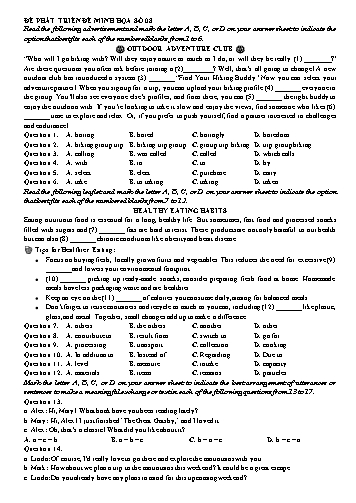
ĐỀ PHÁT TRIỂN ĐỀ MINH HỌA SỐ 08 Read the following advertisement and mark the letter A, B, C, or D on your answer sheet to indicate the option that best fits each of the numbered blanks from 1 to 6. OUTDOOR ADVENTURE CLUB “Who will I go hiking with? Will they enjoy nature as much as I do, or will they be really (1) _______?” Are these questions you often ask before joining a (2)________? Well, that’s all going to change! A new outdoor club has introduced a system (3) _______ “Find Your Hiking Buddy.’ Now you can select your adventure partner! When you sign up for a trip, you can upload your hiking profile (4) _______ everyone in the group. You’ll also see everyone else’s profiles, and from there, you can (5) _______ the right buddy to enjoy the outdoors with. If you’re looking to take it slow and enjoy the views, find someone who likes (6) _______ time to explore and relax. Or, if you prefer to push yourself, find a partner interested in challenges and endurance! Question 1. A. boring B. bored C. boringly D. boredom Question 2. A. hiking group trip B. hiking trip group C. group trip hiking D. trip group hiking Question 3. A. calling B. was called C. called D. which calls Question 4. A. with B. in C. to D. by Question 5. A. select B. elect C. purchase D. carry Question 6. A. take B. to taking C. taking D. taken Read the following leaflet and mark the letter A, B, C, or D on your answer sheet to indicate the option that best fits each of the numbered blanks from 7 to 12. HEALTHY EATING HABITS Eating nutritious food is essential for a long, healthy life. But sometimes, fast food and processed snacks filled with sugars and (7) _______ fats are hard to resist. These products are not only harmful to our health but can also (8) _______ chronic conditions like obesity and heart disease. Tips for Healthier Eating: ● Focus on buying fresh, locally grown fruits and vegetables. This reduces the need for excessive (9) _______ and lowers your environmental footprint. ● (10) _______ picking up ready-made snacks, consider preparing fresh food at home. Homemade meals have less packaging waste and are healthier. ● Keep an eye on the (11) _______ of calories you consume daily, aiming for balanced meals. ● Don’t forget to reuse containers and recycle as much as you can, including (12) _______ like plastic, glass, and metal. Together, small changes add up to make a difference. Question 7. A. others B. the others C. another D. other Question 8. A. contribute to B. result from C. switch to D. go for Question 9. A. processing B. transport C. collection D. cooking Question 10. A. In addition to B. Instead of C. Regarding D. Due to Question 11. A. level B. measure C. intake D. capacity Question 12. A. materials B. items C. remains D. particles Mark the letter A, B, C, or D on your answer sheet to indicate the best arrangement of utterances or sentences to make a meaningful exchange or text in each of the following questions from 13 to 17. Question 13. a. Alex: Hi, Mary! What book have you been reading lately? b. Mary: Hi, Alex! I just finished "The Great Gatsby," and I loved it. c. Alex: Oh, that’s a classic! What did you like about it? A. a – c – b B. a – b – c C. b – a – c D. b – c – a Question 14. a. Linda: Of course, I’d really love to go there and explore the mountains with you. b. Mark: How about we plan a trip to the mountains this weekend? It could be a great escape. c. Linda: Do you already have any plans in mind for this upcoming weekend? d. Mark: That’s wonderful! I’ll take care of all the arrangements and book everything in advance. e. Linda: That sounds perfect to me! I really need a break from all the stress at work. A. c – b – a – e – d B. c – d – e – a – b C. c – b – a – e – d D. b – a – d – e – c Question 15. Hi Alice, a. That would be a perfect opportunity for us to escape from the city and breathe in some fresh mountain air! b. I have been thinking about planning a small, relaxing trip to the mountains this weekend to unwind a bit. c. Let me know if you’re interested in joining; I think it could be a lot of fun! d. The weather forecast looks absolutely ideal for some hiking and exploring. e. It’s been quite some time since our last outdoor adventure together, don’t you think? Write back soon, Sam A. b – d – e – a – c B. a – e – b – d – c C. e – d – a – b – c D. c – b – d – a – e Question 16. a. In short, small steps like reducing plastic use, conserving water, and recycling can collectively make a significant impact on the health of our planet and future generations. b. Consequently, as these practices become more popular, communities around the world are becoming increasingly aware of environmental issues and their role in addressing them. c. Environmental awareness, sparked by education and activism, has grown significantly in recent years, creating a shift in public attitudes toward sustainability. d. Individuals everywhere are now more conscious about their lifestyle choices, opting for eco-friendly products and cutting down on wasteful habits. e. Many people are adopting sustainable practices, like using renewable energy and supporting green businesses, to contribute positively to the planet. A. c – b – d – e – a B. a – c – d – e – b C. d – b – e – c – a D. b – d – c – e – a Question 17. a. Some people worry about the ethical implications of AI, especially concerning privacy, data security, and the potential misuse of personal information. b. Others believe that the widespread implementation of AI may eventually replace a significant number of human jobs, especially in sectors that rely heavily on routine tasks. c. Ultimately, AI is a powerful tool that must be managed carefully to maximize its benefits while minimizing its drawbacks for society. d. Despite these concerns, AI offers enormous benefits for society, such as improving healthcare, streamlining administrative processes, and increasing access to information. e. Governments and policymakers around the world are working to create comprehensive regulations for AI use, aiming to address its potential risks and ensure ethical practices. A. c – e – a – d – b B. a – b – d – e – c C. a – d – c – e – b D. d – b – e – a – c Read the following passage about technology in healthcare and mark the letter A, B, C, or D on your answer sheet to indicate the option that best fits each of the numbered blanks from 18 to 22. In recent years, technology has rapidly transformed the healthcare industry. Various devices and software systems, such as digital health records and diagnostic tools, (18) _______. These advancements have enabled healthcare providers to store, retrieve, and analyze patient information more effectively. For instance, artificial intelligence systems can scan thousands of medical records, (19) _______. However, while these innovations bring numerous benefits, there are concerns about data security and patient privacy. Telemedicine is another significant development, allowing patients to consult doctors remotely. (20) _______. This technology is particularly useful for people in remote areas, as it saves time and reduces travel costs. During the COVID-19 pandemic, telemedicine became essential for healthcare systems globally, helping to reduce patient overcrowding. (21) _______. Telemedicine will likely continue to play an important role in healthcare delivery even after the pandemic. While technology can enhance healthcare quality, (22) _______. Therefore, it’s essential to find a balance between technological and human interaction to ensure the best outcomes for patients. Question 18. A. having been implemented to enhance the storage and analysis of patient data B. are used by hospitals to monitor, store, and evaluate extensive medical information C. that enable medical professionals to track and review patient health histories conveniently D. combining advanced diagnostics with storage systems to improve healthcare accuracy Question 19. A. which is used to analyze large amounts of patient health data too efficiently B. that has proven ineffective in evaluating complex health data at high speeds C. and identify patterns that help diagnose diseases accurately and swiftly D. using AI to study health records for improved diagnostics and health strategies Question 20. A. Virtual consultations give patients access to specialists without travel or waiting times B. Telemedicine provides healthcare access to patients in urban areas C. Many patients benefit from virtual consultations that increase physical visits to clinics D. It allows patients to consult specialists offline, avoiding waiting times and commutes Question 21. A. Patients who rely on telemedicine underestimate its effectiveness in treatment accessibility B. It hasn’t been integrated as an essential service to reduce in-person medical visits C. Virtual consultations are a key component of healthcare despite reduced in-person visits D. Telemedicine has ensured healthcare access, especially during high-demand times Question 22. A. human touch isn’t still crucial in healthcare, despite advancements in medical technology B. the role of technology must be carefully balanced with personal patient interactions C. healthcare workers believe in maintaining either technological or personal care elements D. combining high-tech tools with compassion is unnecessary to improve patient care experiences Read the following passage about endangered languages and mark the letter A, B, C or D on your answer sheet to indicate the best answer to each of the following questions from 23 to 30. Bees play a crucial role in our ecosystem, contributing significantly to the pollination of many plants. They are responsible for pollinating a large portion of the crops we eat, including fruits, vegetables, and nuts. In fact, approximately one-third of the food produced globally relies on bee pollination. This essential process supports not only our food supply but also maintains biodiversity by enabling various plant species to thrive. Unfortunately, bee populations are declining due to habitat loss, pesticide use, and climate change. Urbanization has also contributed to the loss of natural habitats, putting further pressure on these vital creatures. This decline poses a significant threat to food security and the environment, making it vital for us to take action. Many organizations and scientists are deeply concerned about this issue and are working tirelessly to find solutions that can help stabilize bee populations. To combat this problem, numerous initiatives are being launched to promote bee-friendly practices. These include planting wildflowers, reducing chemical use, and creating urban green spaces that support bee habitats. Some cities have even established urban bee farms to enhance local populations, thereby raising community awareness about the importance of bees. Educational programs in schools also aim to foster an appreciation for the role bees play in our lives and ecosystems. Educating the public about the vital role bees play is essential for conservation efforts. If we do not take action, the loss of bee populations could lead to dire consequences for both the environment and human health. Initiatives like community gardens and educational workshops are excellent examples of how local communities can contribute to bee conservation. Protecting bees is not just an environmental issue; it is crucial for ensuring a stable food supply for future generations. Question 23. Which of the following is NOT mentioned as a reason for the decline in bee populations? A. Habitat loss B. Pesticide use C. Urbanization D. Climate change Question 24. The word dire in paragraph 4 is OPPOSITE in meaning to _______. A. terrible B. calamitous C. available D. useful Question 25. The word They in paragraph 1 refers to _______. A. crops B. bees C. organizations D. wildflowers Question 26. The word foster in paragraph 3 could be best replaced by _______. A. hinder B. promote C. discourage D. challenge Question 27. Which of the following best paraphrases the underlined sentence in paragraph 4? A. Awareness of bees is insignificant for saving them in balancing the biodiversity. B. People need to know about the importance of bees for effective conservation. C. Many people know about bees but don’t help them to survive. D. A lack of awareness prevents people from helping bees. Question 28. Which of the following is TRUE according to the passage? A. Urban farming can negatively impact bee populations. B. Bees are not important for food production. C. Conservation efforts include educating the public about bees. D. Pesticides have no effect on bee populations. Question 29. In which paragraph does the writer mention a present causal relationship? A. Paragraph 1 B. Paragraph 2 C. Paragraph 3 D. Paragraph 4 Question 30. In which paragraph does the writer discuss actions being taken to protect bees? A. Paragraph 1 B. Paragraph 2 C. Paragraph 3 D. Paragraph 4 Read the following passage about endangered languages and mark the letter A, B, C or D on your answer sheet to indicate the best answer to each of the following questions from 31 to 40. [I] Social media has rapidly changed how people communicate, making it easier than ever to connect with friends and family. [II] Platforms like Facebook, Twitter, and Instagram allow people to share updates, photos, and ideas instantly, connecting users from all around the world. [III] However, the shift to online communication also brings challenges, such as reduced face-to-face interactions, and for many, the art of personal, meaningful conversation is becoming lost. [IV] Additionally, social media influences public opinion and spreads information quickly, which can have both positive and negative impacts on users' perception of current events. While social media connects people globally, it has also led to an increased risk of misinformation. When incorrect information spreads, it can have significant consequences. For example, rumors or misleading news can shape opinions on important issues or damage reputations unfairly. Additionally, platforms that encourage the rapid sharing of content often prioritize engagement over accuracy, which only worsens the spread of false information. To address this, social media companies are beginning to implement fact-checking systems and remove harmful content, though these measures are not foolproof. Despite these efforts, social media remains a powerful tool for influencing public discourse. Many people rely on social platforms for news and updates, making them crucial channels for political campaigns and social movements. In recent years, social media has played a pivotal role in organizing protests, spreading awareness on social issues, and amplifying voices that may otherwise go unheard. From climate change activism to political campaigns, social media continues to drive social change across the globe—a true force to be reckoned with. As social media’s role in communication continues to evolve, individuals are urged to use it responsibly. Educators, parents, and policymakers emphasize the importance of teaching people, especially young users, to critically evaluate the information they encounter online. Responsible usage not only helps combat misinformation but also promotes constructive dialogue in an increasingly connected world. Social media is an indispensable tool, but like any tool, it requires careful use to yield the best results. Question 31. Where in paragraph 1 does the following sentence best fit? "People of all ages are now turning to social media for entertainment and information." A. [I] B. [II] C. [III] D. [IV] Question 32. The phrase " force to be reckoned with " in paragraph 3 could best be replaced by _______. A. something large B. something influential C. something affected D. something debated Question 33. The word "them" in paragraph 3 refers to _______. A. people B. voices C. news channels D. social platforms Question 34. According to paragraph 2, which of the following is NOT a risk associated with social media? A. Misinformation B. Damaged reputations C. Political activism D. Incorrect public opinion Question 35. Which of the following best summarises paragraph 3? A. Social media is increasingly used to promote commercial products. B. Online platforms play a major role in shaping news and public opinion. C. News platforms rely on social media to communicate with their audience. D. Social media platforms prevent the spread of misinformation effectively. Question 36. The word "reduced" in paragraph 1 is OPPOSITE in meaning to _______. A. expanded B. decreased C. limited D. lowered Question 37. Which of the following is TRUE according to the passage? A. Social media companies are fully successful in stopping misinformation. B. Most people do not trust information shared on social media. C. Social media has a strong influence on public discourse and activism. D. The spread of information on social media is limited to personal updates. Question 38. Which of the following best paraphrases the sentence "Social media’s role in communication continues to evolve" in paragraph 4? A. Social media remains the most popular tool for global communication. B. The way people communicate on social media is constantly changing. C. Social media has finally reached its peak in communication. D. There is little change in how social media affects communication. Question 39. Which of the following can be inferred from the passage? A. Social media has replaced traditional news channels completely. B. People need to be cautious when trusting information on social media. C. Social media limits opportunities for social interaction. D. Fact-checking prevents all misinformation on social platforms. Question 40. Which of the following best summarises the passage? A. Social media, while connecting people globally, presents new challenges in communication that require critical evaluation of information. B. The growth of social media ensures that only accurate information reaches the public. C. Platforms like Facebook focus primarily on entertaining users rather than informing them. D. Misinformation spread on social media leads to positive social outcomes. --------------------- THE END --------------------- - Thí sinh không sử dụng tài liệu. - Giám thị coi thi không giải thích gì thêm. 1 A 11 C 21 D 31 B 2 A 12 A 22 B 32 A 3 C 13 B 23 C 33 D 4 C 14 A 24 D 34 C 5 A 15 A 25 B 35 B 6 C 16 A 26 B 36 A 7 D 17 B 27 B 37 C 8 A 18 B 28 C 38 B 9 B 19 C 29 B 39 B 10 B 20 A 30 C 40 A
File đính kèm:
- de_minh_hoa_tot_nghiep_thpt_tieng_anh_de_8_co_dap_an.doc