Đề thi tốt nghiệp THPT Tiếng Anh - Đề số 4 (Có đáp án)
 20 Trang
33
20 Trang
33
Bạn đang xem tài liệu "Đề thi tốt nghiệp THPT Tiếng Anh - Đề số 4 (Có đáp án)", để tải tài liệu gốc về máy hãy click vào nút Download ở trên.
Tóm tắt nội dung tài liệu: Đề thi tốt nghiệp THPT Tiếng Anh - Đề số 4 (Có đáp án)
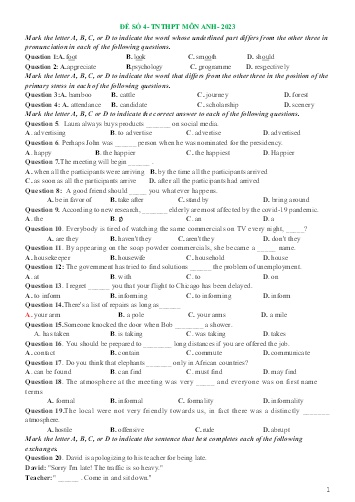
 ĐỀ SỐ 4- TNTHPT MƠN ANH- 2023
Mark the letter A, B, C, or D to indicate the word whose underlined part differs from the other three in
pronunciation in each of the following questions.
Question 1:A. foot B. look C. smooth D. should
Question 2: A.appreciate B.psychology C. programme D. respectively
Mark the letter A, B, C, or D to indicate the word that differs from the other three in the position of the
primary stress in each of the following questions.
Question 3:A. bamboo B. cattle C. journey D. forest
Question 4: A. attendance B. candidate C. scholarship D. scenery
Mark the letter A, B, C or D to indicate the correct answer to each of the following questions.
Question 5. Laura always buys products _______ on social media.
A. advertising B. to advertise C. advertise D. advertised
Question 6. Perhaps John was ______ person when he was nominated for the presidency.
A. happy B. the happier C. the happiest D. Happier
Question 7.The meeting will begin ______ .
A. when all the participants were arriving B. by the time all the participants arrived
C. as soon as all the participants arrive D. after all the participants had arrived
Question 8: A good friend should _____ you whatever happens.
 A. be in favor of B. take after C. stand by D. bring around
Question 9. According to new research, _______ elderly are most affected by the covid-19 pandemic.
A. the B. ∅ C. an D. a
Question 10. Everybody is tired of watching the same commercials on TV every night, _____?
 A. are they B. haven't they C. aren't they D. don't they
Question 11. By appearing on the soap powder commercials, she became a _____ name.
A. housekeeper B. housewife C. household D. house
Question 12: The government has tried to find solutions ______ the problem of unemployment.
A. at B. with C. to D. on
Question 13. I regret ______ you that your flight to Chicago has been delayed.
A. to inform B. informing C. to informing D. inform
Question 14.There's a list of repairs as long as______
A. your arm B. a pole C. your arms D. a mile
Question 15.Someone knocked the door when Bob ________ a shower.
 A. has taken B. is taking C. was taking D. takes
Question 16. You should be prepared to ________ long distances if you are offered the job.
A. contact B. contain C. commute D. communicate
Question 17. Do you think that elephants _______ only in African countries?
A. can be found B. can find C. must find D. may find
Question 18. The atmosphere at the meeting was very _____ and everyone was on first name
terms
 A. formal B. informal C. formality D. informality
Question 19.The local were not very friendly towards us, in fact there was a distinctly _______
atmosphere.
 A. hostile B. offensive C. rude D. abrupt
Mark the letter A, B, C, or D to indicate the sentence that best completes each of the following
exchanges.
Question 20. David is apologizing to his teacher for being late.
David: "Sorry I'm late! The traffic is so heavy."
Teacher:" ______ . Come in and sit down.''
 1
 A. Thank you B. You're so kind
 C. Me neither D. It's alright
Question 21: Susan shared with her friend about her losing purse,
Susan: "I have lost my purse."
Her friend: " ______ ."
 A. it's careless B. Oh, what a pity
 C. That's nothing D. Oh, be careful
Mark the letter A, B, C, or D on your answer sheet to indicate the word(s) OPPOSITE in meaning to the
underlined word(s) in each of the following questions.
Question 22.Because of his disease, the doctor advised him to desist from alcohol and meat. However, he
seems not to follow this advice.
 A. continue B. cease C. abstain D. undermine
Question 23. Most families in my village have been on the breadline since the covid-19 pandemic broke
out.
 A. healthy B. exhausted C. poor D. wealthy
Mark the letter A, B, C, or D on your answer sheet to indicate the word(s) CLOSEST in meaning to the
underlined word(s) in each of the following questions.
Question 24.Today hectic lifestyles also prevent us from spending as much time as we should on staying
in shape.
A. happy B. idle C. free D. occupied
Question 25. Cycling would be a practical approach to the problem of air pollution in this city.
A. debate B. review C. solution D. conclusion
Mark the letter A, B, C, or D to indicate the sentence that is closest in the meaning to each of the
following questions.
Question 26. It’s unnecessary for your daughter to go out at this time at night.
A. Your daughter may not go out at this time at night.
B. Your daughter must go out at this time at night.
C. Your daughter needn’t go out at this time at night.
D. Your daughter should go out at this time at night.
Question 27. He last talked to his wife 3 weeks ago.
A. He hasn’t talked to his wife for 3 weeks. B. He didn’t talk to his wife 3 weeks ago.
C. He had talked to his wife for 3 weeks. D. He talked to his wife for 3 weeks.
Question 28. “When will the movie Chuyen Xom Tui: Con Nhot Mot Chong be on at this theater?”,
asked my mother.
A. My mother asked me when will the movie Chuyen Xom Tui: Con Nhot Mot Chong be on at that
theater.
B. My mother asked me when the movie Chuyen Xom Tui: Con Nhot Mot Chong will be on at that
theater.
C. My mother asked me when the movie Chuyen Xom Tui: Con Nhot Mot Chong would be on at that
theater.
D. My mother asked me when would the movie Chuyen Xom Tui: Con Nhot Mot Chong be on at that
theater.
Mark the letter A, B, C or D on your answer sheet to indicate the underlined part that needs
correction in each of the following questions.
Question 29. Several cases of school volition have taken place, which are due to disagreements or
disparagement by other students.
 2
 A. disagreements B. other C. volition D. Several
Question 30. We will have lunch outside yesterday because the weather was good.
A. good B. outside C. the D. will have
Question 31. Although gestures are very useful, it still have major disadvantages in communication.
A. useful B. it C. are D. communication
Mark the letter A, B, C, or D to indicate the sentence that best combines each pair of sentences in
the following questions.
Question 32. He doesn’t have enough money. Therefore, he can’t buy that house.
A. If he had had enough money, he could have bought that house.
B. If he had enough money, he could buy that house.
C. If he has enough money, he can’t buy that house.
D. If he had enough money, he couldn’t buy that house.
Question 33. He had turned on his new phone. There were many missed calls right after that.
A. As soon as there were many missed calls, he turned on his new phone.
B. Only after there had been many missed calls did he turn on his new phone.
C. No sooner had he turned on his new phone than there were many missed calls.
D. Scarely had he turned on his new phone than there were many missed calls.
Read the following passage and mark the letter A, B, C, or D on your answer sheet to indicate the
correct word or phrase that best fits each of the numbered blanks from 34 to 38
When John Paul Yong sang his disco classic Love Is in the air, he probably wasn’t thinking about human
beings (34) ______ smells into the atmosphere to attract potential mates. However, the success of this
song in the 1990s coincided with an increasing interest from the scientific community in discovering why
people fall in love.
The first scientists to investigate love in depth were sociologists, and they quickly destroyed the common
belief that people fall in love with each other because of (35) ______. They discovered that reality was
much less romantic. In 2005, sociologists Christine R Schwartz and Robert D Mare presented a paper on
their extensive study of couples (36) ______ had married between 1940 and 2005 that showed that people
very rarely marry someone who has a different level of education from theirs. Neither, according to
research by (37) ______academics, do we fall for people from different socioeconomic backgrounds, nor
with different beliefs. Sociologists concluded that we want to go out with people who are just like us. (38)
______, you can walk into a room level of education, intelligence and looks as you, and you are unlikely
to fall in love with any of them.
 (Adapted from Solutions – Third Edition – Upper-intermediate – Student’s book – Unit 5 - page 58)
Question 34. A. expand B. release C. maintain D. deplete
Question 35. A. mindset B. lifestyle C. career D. destiny
Question 36. A. who B. which C. whom D. whose
Question 37. A. other B. every C. others D. others
Question 38. A. Despite B. However C. Therefore D. Because
Read the following passage and mark the letter A, B, C, or D on your answer sheet to indicate the
correct word or phrase that best fits each of the numbered blanks from 39 to 43
 The typical way of talking to a baby – high-pitched, exaggerated and repetitious – is a source of
fascination for linguists who hope to understand how ‘baby talk’ impacts on learning. Most babies start
developing their hearing while still in the womb, prompting some hopeful parents to play classical music
to their pregnant bellies. Some research even suggests that infants are listening to adult speech as early as
10 weeks before being born, gathering the basic building blocks of their family’s native tongue.
 Early language exposure seems to have benefits to the brain – for instance, studies suggest that
babies raised in bilingual homes are better at learning how to mentally prioritize information. So how
 3
 does the sweet if sometimes absurd sound of infant-directed speech influence a baby’s development?
Here are some recent studies that explore the science behind baby talk.
 Scientists from the University of Washington and the University of Connecticut collected thousands
of 30-second conversations between parents and their babies, fitting 26 children with audio-recording
vests that captured language and sound during a typical eight-hour day. The study found that the more
baby talk parents used, the more their youngsters began to babble. And when researchers saw the same
babies at age two, they found that frequent baby talk had dramatically boosted vocabulary, regardless of
socioeconomic status. “Those children who listened to a lot of baby talk were talking more than the
babies that listened to more adult talk or standard speech,” says Nairán Ramirez-Esparza of the University
of Connecticut. “We also found that it really matters whether you use baby talk in a one-on-one context,”
she adds. ‘The more parents use baby talk one-on-one, the more babies babble, and the more they babble,
the more words they produce later in life.’
 (Adapted from Cambridge IELTS 13 Reading – Test 03)
answer/KKYZfXszIG7l9y
Question 39. Which of the following can be the best title for the passage?
A. A baby’s development
B. 30-second conversations between parents and their babies
C. Baby talk and their ability to hear classical music
D. How baby talk gives infant brains a boost
Question 40. The word “their” in paragraph 1 refers to _______
A. brains B. parents C. impacts D. babies
Question 41. The word “babble” in the paragraph 3 is closet in meaning to _______
A. to learn quickly and easily B. to sleep well and a lot more
C. to listen clearly and attentively D. to talk quickly and unintelligibly
Question 42. According to paragraph 1, most infants begin to developing their hearing ______.
A. even when in the house B. even when in the womb
C. even when in 10 days D. even when in the building
Question 43. Which of the following is NOT TRUE about the studies of the University of Washington
and Connecticut in paragraph 3?
A. Parents use adult talk more, their babies tend to talk more.
B. Their babies babble more, they tend to produce more words later in life.
C. Parents use baby talk more, their children's babbling increased.
D. Numerous 30-second conversations between parents and babies were recorded during a typical eight-
hour day.
Read the following passage and mark the letter A, B, C, or D on your answer sheet to indicate the
correct word or phrase that best fits each of the numbered blanks from 44 to 50
 The first newspapers appeared in the 17th century, but ordinary people didntt use to buy them often
because they were expensive. This changed in the 1850s with the invention of powerful printing presses,
which could print 10,000 papers per hour. As a result, newspaper prices came down and more people
could afford to buy them. Thanks to another new invention, the photograph, it was also the first time that
newspapers contained pictures as well as articles.
 When a volcano erupted on the Pacific island of Krakatoa in 1883, it killed 36.000 people. It was one
of the worst natural disasters in history. It was also significant because it was the first time that news could
travel around the world in minutes, using undersea electrical telegraph wires. Before the telegraph was
invented, it used to take weeks far news to travel to a different continent. News of Abraham Lincoln's
death, for example, took nearly two weeks to reach Europe in 1865.
 4
 In the early 20th century, before televisions became popular, people used to go to the cinema to
watch the news. Ten-minute films called “news reels” contained moving images of four or five top news
stories. The news reels were changed weekly, not daily, so the news wasn't always up to date. Nowadays,
they are important as historical documents, as they provide the only audiovisual records of those times.
 At the start of the 21st century, developments in smartphone technology and the growth at social
media like Twitter, Facebook and Instagram have completely changed the way that we get our news. Now
anybody can report news. This is sometimes called “citizen journalism.” One of the first and most famous
examples of it happened in New York in 2009 when a plane carrying 150 passengers landed in the
Hudson River after a flock of birds flew into the plane's engine. People who saw the crash posted
comments and photos on Twitter and the news spread around the world in minutes. Professional
journalists didn't arrive at the scene until 15 minutes later
 (Adapted from Navigate Pre-Intermediate B1 Coursebook, Julie Norton, Caroline Krantz,
 OXFORD UP ELT, 2015 - page 108)
Question 44. Which of the following could be the best title of the passage?
A. the disappearance of newspapers B. documentary styles
C. Media milestones D. the benefits of smartphone technology
Question 45. The word “they” in paragraph 3 refers to _______
A. Ten-minute films B. The news reels
C. news stories D. historical documents
Question 46. The word “erupted” in the paragraph 2 is closet in meaning to _______
A. exploded and flamed B. boiled C. disappeared D. eroded
Question 47. According to paragraph 1, newspaper costs decreased, more people could afford to
purchase them because of ______
A. volcanic eruption on the Pacific island B. the first newspapers
C. ordinary people D. the invention of powerful printing presses
Question 48. The word “came down” in paragraph 1 is closet in meaning to _______
A. got lower B. became stronger C. got more popular D. got hellishly expensive
Question 49. According to the passage, which of the following is TRUE according to the paragraph 3?
A. People didn’t visit the local movie theater to see the news when televisions became popular
B. Not every day, but every week, the news reels were altered.
C. The news reels are cartoon films
D. Moving images provide the only audiovisual records of those times.
Question 50. Which of the following can be inferred from “citizen journalism.” in paragraph 4?
A. It means that writing activities about hot news are carried out by citizens rather than journalists.
B. It means that this new concept doesn’t allow all citizens to participate in journalism.
C. It means that minimize the role of community.
D. It means that the citizen journalism trend has completely changed newspapers.
 THE END
 5
 LỜI GIẢI CHI TIẾT ĐỀ SỐ 4- TNTHPT MƠN ANH- 2023
Mark the letter A, B, C, or D to indicate the word whose underlined part differs from the other three in
pronunciation in each of the following questions.
Question 1:A. foot B. look C. smooth D. should
Question 1:C
Kiến thức về phát âm
A. foot /fʊt/ B. look /lʊk/
C. smooth /smu:ð/ D. Should flʊd/
=> Phương án C phần gạch chân được phát âm là /u:/, các phương án cịn lại được phát âm là /ʊ/.
Question 2: A.appreciate B.psychology C. programme D. respectively
Question 2: B
A. appreciate :/əˈpriː.ʃi.eɪt/
B. psychology:/saɪˈkɒl.ə.dʒi/
C. programme: /ˈprəʊ.ɡrỉm/
D. programme:/rɪˈspek.tɪv.li/
Kiến thức về phát âm
=> Câu B “P” là âm câm cịn các đáp án cịn lại được phát âm là /p/.
Mark the letter A, B, C, or D to indicate the word that differs from the other three in the position of the
primary stress in each of the following questions.
Question 3:A. bamboo B. cattle C. journey D. forest
 Question 3:A
 A. bamboo : /bỉmˈbuː/
 B. cattle :/ˈkỉt.ə/
 C. journey :/ˈdʒɜː.ni/
 D. forest :/ˈfɒr.ɪst/
Đáp án A vào âm 2 cịn lại đáp án cịn là là âm 1
Question 4: A. attendance B. candidate C. scholarship D. scenery
Question 4:A
A. attendance :/əˈten.dəns/
B. candidate :/ˈkỉn.dɪ.dət/
C. scholarship :/ˈskɒl.ə.ʃɪp/
D. scenery :/ˈsiː.nər.i/
Đáp án A vào âm 2 cịn lại đáp án cịn là là âm 1
Mark the letter A, B, C or D to indicate the correct answer to each of the following questions.
Question 5. Laura always buys products _______ on social media.
A. advertising B. to advertise C. advertise D. advertised
Question 5.D
Giải thích:
Mệnh đề quan hệ rút gọn:
- Câu đầy đủ ‘Laura always buys products which are advertised on social media.’
- Vì mệnh đề quan hệ là mệnh đề bị động nên được rút gọn về dạng quá khứ phân từ.
Tạm dịch: Laura luơn mua những sản phẩm được quảng cáo trên mạng xã hội.
Question 6. Perhaps John was ______ person when he was nominated for the presidency.
A. happy B. the happier C. the happiest D. Happier
Question 6.C
Giải thích:
Cấu trúc so sánh nhất với tính từ/trạng từ ngắn:
 6
 S + to be/V + the + adj/adv – est
- Những tính từ/ trạng từ cĩ 2 âm tiết kết thúc bằng phụ âm y –> ta đổi y thành i và thêm -est. Ví dụ: dry
=> driest, happy => happiest.
Tạm dịch: Cĩ lẽ John là người hạnh phúc nhất khi được đề cử cho chức vụ tổng thống.
Question 7.The meeting will begin ______ .
A. when all the participants were arriving B. by the time all the participants arrived
C. as soon as all the participants arrive D. after all the participants had arrived
Question 7:C
Giải thích:
Sự phối thì:
Ta cĩ: TLĐ + liên từ + HTĐ
Lưu ý: Ta khơng kết hợp thì TLĐ/TLHT với các thì quá khứ.
Tạm dịch: Cuộc họp sẽ bắt đầu ngay sau khi tất cả những người tham gia đến.
Question 8: A good friend should _____ you whatever happens.
 A. be in favor of B. take after C. stand by D. bring around
Question 8: C
Kiến thức về cụm động từ
A. be in favor of: thích, ưa chuộng
B. take after: giống
C. stand by: ở bên. ủng hộ
D. bring around: thuyết phuc/mang cái gì đi cùng khi bạn đến thăm/ làm cho ai đĩ
nĩi về điều gì
Dịch nghĩa: Một người bạn tốt nên ở bên cạnh bạn dù cho cĩ bất cứ chuyện gì xảy ra.
Question 9. According to new research, _______ elderly are most affected by the covid-19 pandemic.
A. the B. ∅ C. an D. a
Question 9:A
Giải thích:
Kiến thức mạo từ:
Ta sử dụng mạo từ “the” trước tính từ elderly để chỉ một tầng lớp người trong xã hội.
Tạm dịch: Theo nghiên cứu mới, người cao tuổi bị ảnh hưởng nhiều nhất bởi đại dịch Covid-19.
Question 10. Everybody is tired of watching the same commercials on TV every night, _____?
 A. are they B. haven't they C. aren't they D. don't they
Question 10. C
Kiến thức câu hỏi đuơi,
Chủ ngữ là "everybody" => Đại từ trong câu hỏi đuơi là “they".
Động từ chính là “are” dạng khẳng định => Động từ trong câu hỏi đuơi là "aren't" dạng phủ định.
Tạm dịch: Mọi người đều mệt mỏi khi xem quảng cáo trên tivi mỗi tối, cĩ phải khơng?
Question 11. By appearing on the soap powder commercials, she became a _____ name.
A. housekeeper B. housewife C. household D. house
Question 11.C
Cụm :A household name: được mọi người biết đến, nổi tiếng.
Tạm dịch: Bằng việc xuất hiện trên quảng cáo bột giặt, cơ ấy đã trở nên nổi tiếng.
Question 12: The government has tried to find solutions ______ the problem of unemployment.
A. at B. with C. to D. on
Question 12:C
Giải thích:
Kiến thức về giới từ:
 7
 Solution to sth:giải pháp đối với điều gì
Tạm dịch: Chính phủ đã cố gắng tìm giải pháp cho vấn đề thất nghiệp
Question 13. I regret ______ you that your flight to Chicago has been delayed.
A. to inform B. informing C. to informing D. inform
Question 13.A
Giải thích:
-regret to inform that +mệnh đề :rất lấy làm tiếc để thơng báo với ai đĩ một điều rằng
Tạm dịch: Tơi rất lấy làm tiếc để thơng báo chuyến bay của bạn đến Chicago đã bị hỗn
Question 14.There's a list of repairs as long as______
B. your arm B. a pole C. your arms D. a mile
Question 14.A
Giải thích:thành ngữ "as long as your arm" cĩ nghĩa là rất dài - very long
Tạm dịch: Cĩ một danh sách sửa chữa rất dài.
Question 15.Someone knocked the door when Bob ________ a shower.
 B. has taken B. is taking C. was taking D. takes
Question 15:C
Giải thích:
Thì quá khứ tiếp diễn
QKTD when QKD hoặc When QKTD, QKD: diễn tả hành động đang xảy ra thì hành động khác xen vào.
Tạm dịch: Ai đĩ đã gõ cửa khi Bob đang tắm.
Question 16. You should be prepared to ________ long distances if you are offered the job.
A. contact B. contain C. commute D. communicate
Question 16.C
Giải thích:
contact (v): liên lạc
contain (v): bao gồm
commute (v): đi lại
communicate (v): giao tiếp
Tạm dịch: Bạn cần chuẩn bị cho việc đi lại những quãng đường dài nếu bạn nhận cơng việc đĩ.
Question 17. Do you think that elephants _______ only in African countries?
A. can be found B. can find C. must find D. may find
Question 17.A
Giải thích:
Cấu trúc câu bị động (động từ khuyết thiếu):
S + ĐTKT + be + P2
Tạm dịch: Bạn cĩ nghĩ rằng voi chỉ cĩ thể được tìm thấy ở các nước châu Phi khơng?
Question 18. The atmosphere at the meeting was very _____ and everyone was on first name
terms
 A. formal B. informal C. formality D. informality
Question 18.B
Kiến thức về từ loại
 A. formal (adj): trang trọng B. informal (adj): khơng trang trọng/ thân thiết
 C. formality (n): sự trang trọng D. informality (n): sự khơng trang trọng
Sau động từ be (was) dùng tính từ => loại C và D.
 Dịch nghĩa: Bầu khơng khí của cuộc họp rất thân thiết và mọi người gọi nhau bằng tên thân mật.
Question 19.The local were not very friendly towards us, in fact there was a distinctly _______
atmosphere.
 A. hostile B. offensive C. rude D. abrupt
 8
 Question 19.A
Kiến thức về từ vựng
A. hostile (adj): thù địch. khơng thân thiện B. offensive (adj): xúc phạm
C. rude (adj): thơ lỗ D. abrupt (adj): cọc cằn
Dịch nghĩa: Những người dân địa phương khơng thân thiện lắm với chúng tơi, trên thực tế cịn cĩ một bầu
khơng khí thù địch rõ rệt.
Mark the letter A, B, C, or D to indicate the sentence that best completes each of the following
exchanges.
Question 20. David is apologizing to his teacher for being late.
David: "Sorry I'm late! The traffic is so heavy."
Teacher:" ______ . Come in and sit down.''
 A. Thank you B. You're so kind
 C. Me neither D. It's alright
Question 20: D
Tình huống giao tiếp
Giải thích:
A. Cảm ơn
B. Bạn tốt bụng quá
C. Tơi cũng khơng
D. Khơng sao đâu
Tạm dịch: David đang xin lỗi giáo viên của mình vì đã đến muộn.
David: "Xin lỗi, em đến muộn! Tắc đường quá luơn ạ."
Thầy: "Khơng sao đâu. Em vào ngồi đi. ''
Question 21: Susan shared with her friend about her losing purse,
Susan: "I have lost my purse."
Her friend: " ______ ."
 A. it's careless B. Oh, what a pity
 C. That's nothing D. Oh, be careful
Question 21:B
Tình huống giao tiếp
Tạm dịch: Susan chia sẻ với bạn của cơ về chiếc ví bị mất của mình.
Susan: “Tớ đã bị mất ví.”
Bạn của cơ: “_________.”
A. Nĩ thật bất cẩn. B. Ơi, thật đáng tiếc.
C. Khơng cĩ gì. D. Ơi, hãy cẩn thận.
Mark the letter A, B, C, or D on your answer sheet to indicate the word(s) OPPOSITE in meaning to the
underlined word(s) in each of the following questions.
Question 22.Because of his disease, the doctor advised him to desist from alcohol and meat. However, he
seems not to follow this advice.
 A. continue B. cease C. abstain D. undermine
Question 22.A
Tạm dịch: Vì bệnh tật của anh ta nên bác sĩ đã khuyên anh nên kiêng chất cồn và thịt. Tuy nhiên, anh ta
dường như chẳng thể làm theo lời khuyên này.
-desist /dɪˈsɪst/ (v): (+from doing sth) ngừng, bỏ làm gì (do ai đĩ khơng muốn bản thân làm) ><- continue
/kənˈtɪnjuː/ (v): (+to Vo/doing sth) duy trì, tiếp tục
-cease /ɪnˈkriːs/ (v)+Ving: dừng,ngừng làm gì
 9
 -abstain /ỉbˈsteɪn/ (v): (+from sth/doing sth) tránh làm gì hoặc hưởng một lạc thú gì (thường là điều gây
hại); kiêng, nhịn làm gì
- undermine /ˌʌndəˈmaɪn/ (v): làm suy yếu dần dần, phá hoại ngầm
Cấu trúc khác cần lưu ý:
+ Advise sb to do sth: khuyên bảo ai làm gì
+ Seem to do sth: dường như, cĩ vẻ sẽ làm gì
Question 23. Most families in my village have been on the breadline since the covid-19 pandemic broke
out.
A. Happy B. exhausted C. poor D. wealthy
Question 23.D
Giải thích:
Kiến thức từ vựng:
- happy (adj): hạnh phúc
- exhausted (adj): mệt mỏi
- poor (adj): nghèo
- wealthy (adj): giàu cĩ
Idiom: on the breadline: nghèo rớt mồng tơi >< wealthy
Tạm dịch: Hầu hết các gia đình trong làng của tơi đã nghèo rớt mồng tơi kể từ khi đại dịch Covid-19
bùng phát.
Mark the letter A, B, C, or D on your answer sheet to indicate the word(s) CLOSEST in meaning to the
underlined word(s) in each of the following questions.
Question 24.Today hectic lifestyles also prevent us from spending as much time as we should on staying
in shape.
A. healthy B. idle C. free D. occupied
Question 24.D
Giải thích:
A. lành mạnh,cĩ sức khỏe B. rảnh rỗi C. rảnh rỗi D. bận rộn
-hectic(adj):bận rộn = occupied(adj). Suy ra đáp án D là phù hợp hợp nhất
Tạm dịch:Ngày nay phong cách sống bận rộn cũng đã ngăn cản chúng tan dành nhiều thời gian vào việc
giữ dáng.
Question 25. Cycling would be a practical approach to the problem of air pollution in this city.
A. debate B. review C. solution D. conclusion
Question 25.C
Giải thích:
Kiến thức từ vựng:
- debate (n): cuộc tranh luận
- review (n): sự xem lại
- solution (n): giải pháp
- conclusion (n): kết luận
approach (n): cách tiếp cận, giải pháp = solution
Tạm dịch: Đi xe đạp sẽ là một cách tiếp cận thiết thực đối với vấn đề ơ nhiễm khơng khí ở thành phố
này.
Mark the letter A, B, C, or D to indicate the sentence that is closest in the meaning to each of the
following questions.
Question 26. It’s unnecessary for your daughter to go out at this time at night.
A. Your daughter may not go out at this time at night.
B. Your daughter must go out at this time at night.
C. Your daughter needn’t go out at this time at night.
 10
 D. Your daughter should go out at this time at night.
Question 26. C
Kiến thức: Động từ khuyết thiếu
Giải thích:
A. Con gái bạn khơng thể đi ra ngồi vào lúc đêm hơm thế này. sai về nghĩa
B. Con gái bạn phải đi ra ngồi vào lúc đêm hơm thế này. sai về nghĩa
C. Con gái bạn khơng cần thiết đi ra ngồi vào lúc đêm hơm thế này. đúng về nghĩa
D. Con gái bạn nên đi ra ngồi vào lúc đêm hơm thế này. sai về nghĩa
 Đáp án C
Tạm dịch: Khơng cần thiết để con gái bạn đi ra ngồi vào lúc đêm hơm thế này.
= Con gái bạn khơng cần thiết đi ra ngồi vào lúc đêm hơm thế này.
Question 27. He last talked to his wife 3 weeks ago.
A. He hasn’t talked to his wife for 3 weeks. B. He didn’t talk to his wife 3 weeks ago.
C. He had talked to his wife for 3 weeks. D. He talked to his wife for 3 weeks.
Question 27. A
Kiến thức: Viết lại câu chuyển đổi thì của động từ.
Ta cĩ: S + last + V2/ed + O + time + ago.
= S + haven’t/hasn’t + V3/ed + O + for/since + time.
 Đáp án A
Dịch nghĩa: Lần cuối cùng anh nĩi chuyện với vợ là 3 tuần trước.
Question 28. “When will the movie Chuyen Xom Tui: Con Nhot Mot Chong be on at this theater?”,
asked my mother.
A. My mother asked me when will the movie Chuyen Xom Tui: Con Nhot Mot Chong be on at that
theater.
B. My mother asked me when the movie Chuyen Xom Tui: Con Nhot Mot Chong will be on at that
theater.
C. My mother asked me when the movie Chuyen Xom Tui: Con Nhot Mot Chong would be on at that
theater.
D. My mother asked me when would the movie Chuyen Xom Tui: Con Nhot Mot Chong be on at that
theater.
Question 28. C
Kiến thức: Câu tường thuật
Giải thích:
Ta cĩ cấu trúc: Chuyển từ câu trực tiếp sang câu gián tiếp dạng câu hỏi với từ để hỏi:
- S + asked (O) / wanted to know / wondered + WH-word + S + V (lùi thì)
Vậy:
“When will the movie Chuyen Xom Tui: Con Nhot Mot Chong be on at this theater?”, asked my mother.
Mẹ tơi hỏi: “Bao giờ bộ phim “Chuyện xĩm tơi: Con Nhĩt Mĩt Chồng” sẽ chiếu ở rạp chiếu phim này?”
= My mother asked me when the movie Chuyen Xom Tui: Con Nhot Mot Chong would be on at that
theater.
(Mẹ tơi hỏi tơi là bao giờ thì bộ phim “Chuyện xĩm tơi: Con Nhĩt Mĩt Chồng” sẽ chiếu ở rạp chiếu phim
đĩ?”
Tạm dịch: Mẹ tơi hỏi: “Bao giờ bộ phim “Chuyện xĩm tơi: Con Nhĩt Mĩt Chồng” sẽ chiếu ở rạp chiếu
phim này?”
Mark the letter A, B, C or D on your answer sheet to indicate the underlined part that needs
correction in each of the following questions.
Question 29. Several cases of school volition have taken place, which are due to disagreements or
disparagement by other students.
 11
 A. disagreements B. other C. volition D. Several
Question 29. C
Kiến thức: Lỗi sai từ vựng
volitionGiải thích: /və ˈlɪʃn/(n): sự mong muốn, ý chí an act of volition: một hành động tự nguyện
Ta chuyển thành:
violence /ˈvaɪələns/(n): bạo lực school violence: bạo lực học đường
 Đáp án C
Tạm dịch: Các vụ bạo lực học đường diễn ra tại một số nơi, do sự bất đồng và sự khinh miệt của
những học sinh với nhau.
Question 30. We will have lunch outside yesterday because the weather was good.
A. good B. outside C. the D. will have
Question 30. D
Kiến thức: Lỗi sai thì của động từ
Giải thích:
 yesterday Đáp án D chia thì quá khứ đơn, vậy ta chuyển: will have had
Tạm dịch: Chúng tơi đã ăn trưa ở ngồi bởi vì hơm qua thời tiết đẹp.
Question 31. Although gestures are very useful, it still have major disadvantages in communication.
A. useful B. it C. are D. communication
Question 31. B
Kiến thức: Lỗi sai đại từ
Giải thích:
 Đápgestures án B dùng đại từ “they” để thay thế
Tạm dịch: Mặc dù cử chỉ rất hữu ích nhưng chúng vẫn cĩ những nhược điểm lớn trong giao tiếp.
Mark the letter A, B, C, or D to indicate the sentence that best combines each pair of sentences in
the following questions.
Question 32. He doesn’t have enough money. Therefore, he can’t buy that house.
A. If he had had enough money, he could have bought that house.
B. If he had enough money, he could buy that house.
C. If he has enough money, he can’t buy that house.
D. If he had enough money, he couldn’t buy that house.
Question 32. B
Kiến thức: Mệnh đề giả định – Điều kiện loại 2
DùngGiải thích: câu điều kiện loại 2 hoặc cấu trúc tương đương để đưa ra giả định trái ngược với thực tế ở hiện tại,
tương lai:
If + S + V2/ed , S + would/could/might + V nguyên mẫu
 didn’t V1
 were / weren’t
QuestionTạm dịch: 33 Anh. He ta had khơng turned cĩ onđủ histiền. new Do phone.đĩ, anh There ta khơng were thể many mua missed căn nhà calls đĩ. right after that.
A. As soon as there were many missed calls, he turned on his new phone.
B. Only after there had been many missed calls did he turn on his new phone.
C. No sooner had he turned on his new phone than there were many missed calls.
D. Scarely had he turned on his new phone than there were many missed calls.
Question 33. C
 12
 Kiến thức: Câu đảo ngữ
Giải thích:
No sooner + had + S + V3/ed + than + S + V2/ed: Vừa mới / Ngay khi ... thì ....
= C. Ngay khi anh vừa mở điện thoại mới của mình thì cĩ rất nhiều cuộc gọi nhỡ.
Tạm dịch: Anh ta mở điện thoại mới của mình. Ngay sau đĩ cĩ rất nhiều cuộc gọi nhỡ.
Read the following passage and mark the letter A, B, C, or D on your answer sheet to indicate the
correct word or phrase that best fits each of the numbered blanks from 34 to 38
When John Paul Yong sang his disco classic Love Is in the air, he probably wasn’t thinking about human
beings (34) ______ smells into the atmosphere to attract potential mates. However, the success of this
song in the 1990s coincided with an increasing interest from the scientific community in discovering why
people fall in love.
The first scientists to investigate love in depth were sociologists, and they quickly destroyed the common
belief that people fall in love with each other because of (35) ______. They discovered that reality was
much less romantic. In 2005, sociologists Christine R Schwartz and Robert D Mare presented a paper on
their extensive study of couples (36) ______ had married between 1940 and 2005 that showed that people
very rarely marry someone who has a different level of education from theirs. Neither, according to
research by (37) ______academics, do we fall for people from different socioeconomic backgrounds, nor
with different beliefs. Sociologists concluded that we want to go out with people who are just like us. (38)
______, you can walk into a room level of education, intelligence and looks as you, and you are unlikely
to fall in love with any of them.
 (Adapted from Solutions – Third Edition – Upper-intermediate – Student’s book – Unit 5 - page 58)
Question 34. A. expand B. release C. maintain D. deplete
Question 34. B
Kiến thức: Từ vựng
release smells into the atmosphere: phát tán mùi hương vào bầu khí quyển
A. expand /ɪkˈspỉnd/ (v): mở rộng
B. release /rɪˈliːs/(v): thải, tỏa
C. maintain /meɪnˈteɪn/ (v): bảo vệ, duy trì
D. deplete /dɪˈpliːt/ (v): rút hết, làm cạn kiệt
Tạm dịch: When John Paul Yong sang his disco classic Love Is in the air, he probably wasn’t thinking
about human beings (34) ______ smells into the atmosphere to attract potential mates. (Khi John Paul
Yong biểu diễn bài hát disco kinh điển "Love in the Air", anh cĩ thể khơng nghĩ rằng con người phát tán
mùi hương vào bầu khí quyển để thu hút bạn tình tiềm năng.)
Question 35. A. mindset B. lifestyle C. career D. destiny
Question 35. D
Kiến thức: Từ vựng
A. mindset /ˈmaɪndset/ (n): định kiến
B. lifestyle /ˈlaɪfstaɪl/ (n): phong cách sống
C. career /kəˈrɪə(r)/ (n): nghề, nghề nghiệp, sự nghiệp
D. destiny /ˈdestəni/ (n): số phận
 the common belief that people fall in love with each other because of destiny: niềm tin phổ biến rằng
con người yêu nhau bởi vì số phận
Tạm dịch: The first scientists to investigate love in depth were sociologists, and they quickly destroyed
the common belief that people fall in love with each other because of (35) ______. (Những nhà khoa học
 13
 đầu tiên đi sâu vào khám phá tình yêu là các nhà xã hội học, và họ đã nhanh chĩng phá hủy niềm tin phổ
biến rằng con người yêu nhau bởi vì số phận.)
Question 36. A. who B. which C. whom D. whose
Question 36. A
Kiến thức: Đại từ quan hệ
Trong mệnh đề quan hệ:
A. which: thay thế cho danh từ chỉ vật; đĩng vai trị chủ ngữ/ tân ngữ
B. who: thay thế cho danh từ chỉ người; đĩng vai trị chủ ngữ; danh từ chỉ người + who + động từ
C. whom: thay thế cho danh từ chỉ người; đĩng vai trị tân ngữ; danh từ chỉ người + whom + chủ ngữ
D. whose: thay thế cho tính từ sở hữu; N + whose + N
 Ta dùng đại từ quan hệ “who” thay thế cho danh từ chỉ người “couples” và đứng ở vị trí chủ ngữ trong
mệnh đề quan hệ
Tạm dịch: In 2005, sociologists Christine R Schwartz and Robert D Mare presented a paper on their
extensive study of couples (36) ______ had married between 1940 and 2005 that showed that people very
rarely marry someone who has a different level of education from theirs. (Năm 2005, các nhà xã hội học
Christine R Schwartz và Robert D Mare đã trình bày một bài báo nghiên cứu sâu rộng về các cặp vợ
chồng người mà kết hơn từ năm 1940 đến năm 2005, trong đĩ chỉ ra rằng mọi người hiếm khi kết hơn với
những người cĩ trình độ học vấn khác với họ.)
Question 37. A. other B. every C. others D. others
Question 37. A
Kiến thức: Lượng từ
A. other + danh từ số nhiều = others
B. every + danh từ số ít: mỗi
C. each + danh từ số ít: mỗi
D. others: thay thế cho cụm: other + danh từ số nhiều, xác định
Tạm dịch: Neither, according to research by (37) ______ academics, do we fall for people from different
socioeconomic backgrounds, nor with different beliefs. (Theo nghiên cứu của các học giả khác, chúng ta
cũng khơng yêu những người cĩ hồn cảnh kinh tế-xã hội khác nhau hoặc tín ngưỡng khác nhau.)
Question 38. A. Despite B. However C. Therefore D. Because
Question 38. B
Kiến thức: Liên từ
A. Despite: Mặc dù (+ N/Ving)
B. However: tuy nhiên
C. Therefore: do đĩ
D. Because: bởi vì
Tạm dịch: Sociologists concluded that we want to go out with people who are just like us. (38) ______,
you can walk into a room level of education, intelligence and looks as you, and you are unlikely to fall in
love with any of them. (Các nhà xã hội học kết luận rằng chúng ta muốn đi chơi với những người như
chúng ta. Tuy nhiên, bạn cĩ thể bước vào một căn phịng cĩ trình độ học vấn, trí tuệ và ngoại hình giống
bạn và bạn khĩ cĩ thể yêu bất kỳ ai trong số họ.)
Dịch tồn bài:
 Khi John Paul Yong biểu diễn bài hát disco kinh điển "Love in the Air", anh cĩ thể khơng nghĩ rằng
con người phát tán mùi hương vào bầu khí quyển để thu hút bạn tình tiềm năng. Tuy nhiên, sự thành cơng
của bài hát trong thập niên 1990 trùng hợp với sự quan tâm ngày càng tăng của giới khoa học trong việc
khám phá ra lý do tại sao mọi người yêu nhau.
 Những nhà khoa học đầu tiên đi sâu vào khám phá tình yêu là các nhà xã hội học, và họ đã nhanh
chĩng phá hủy niềm tin phổ biến rằng con người yêu nhau bởi vì số phận. Họ nhận thấy thực tế ít lãng
mạn hơn nhiều. Năm 2005, các nhà xã hội học Christine R Schwartz và Robert D Mare đã trình bày một
 14
 bài báo nghiên cứu sâu rộng về các cặp vợ chồng kết hơn từ năm 1940 đến năm 2005, trong đĩ chỉ ra rằng
mọi người hiếm khi kết hơn với những người cĩ trình độ học vấn khác với họ. Theo nghiên cứu của các
học giả khác, chúng ta cũng khơng yêu những người cĩ hồn cảnh kinh tế-xã hội khác nhau hoặc tín
ngưỡng khác nhau. Các nhà xã hội học kết luận rằng chúng ta muốn đi chơi với những người như chúng
ta. Tuy nhiên, bạn cĩ thể bước vào một căn phịng cĩ trình độ học vấn, trí tuệ và ngoại hình giống bạn và
bạn khĩ cĩ thể yêu bất kỳ ai trong số họ.
Read the following passage and mark the letter A, B, C, or D on your answer sheet to indicate the
correct word or phrase that best fits each of the numbered blanks from 39 to 43
 The typical way of talking to a baby – high-pitched, exaggerated and repetitious – is a source of
fascination for linguists who hope to understand how ‘baby talk’ impacts on learning. Most babies start
developing their hearing while still in the womb, prompting some hopeful parents to play classical music
to their pregnant bellies. Some research even suggests that infants are listening to adult speech as early as
10 weeks before being born, gathering the basic building blocks of their family’s native tongue.
 Early language exposure seems to have benefits to the brain – for instance, studies suggest that
babies raised in bilingual homes are better at learning how to mentally prioritize information. So how
does the sweet if sometimes absurd sound of infant-directed speech influence a baby’s development?
Here are some recent studies that explore the science behind baby talk.
 Scientists from the University of Washington and the University of Connecticut collected thousands
of 30-second conversations between parents and their babies, fitting 26 children with audio-recording
vests that captured language and sound during a typical eight-hour day. The study found that the more
baby talk parents used, the more their youngsters began to babble. And when researchers saw the same
babies at age two, they found that frequent baby talk had dramatically boosted vocabulary, regardless of
socioeconomic status. “Those children who listened to a lot of baby talk were talking more than the
babies that listened to more adult talk or standard speech,” says Nairán Ramirez-Esparza of the University
of Connecticut. “We also found that it really matters whether you use baby talk in a one-on-one context,”
she adds. ‘The more parents use baby talk one-on-one, the more babies babble, and the more they babble,
the more words they produce later in life.’
 (Adapted from Cambridge IELTS 13 Reading – Test 03)
answer/KKYZfXszIG7l9y
Question 39. Which of the following can be the best title for the passage?
A. A baby’s development
B. 30-second conversations between parents and their babies
C. Baby talk and their ability to hear classical music
D. How baby talk gives infant brains a boost
Question 39. D
Question 39. Ý chính của tác giả trong đoạn văn là gì?
A. Sự phát triển của trẻ. Sai vì thơng tin này chung chung
B. Những cuộc trị chuyện dài 30 giây giữa cha mẹ và bé. Sai, vì những cuộc trị chuyện kéo dài 30
giây chỉ đề cập ở đoạn 3, là ví dụ về 1 cuộc nghiên cứu.
C. Việc trị chuyện với trẻ và khả năng nghe nhạc cổ điển của trẻ. Sai vì thơng tin chỉ nhắc ở đoạn 1
D. Làm thế nào để việc nĩi chuyện với trẻ kích thích não bộ trẻ sơ sinh. Đúng
Căn cứ vào: Vì tồn bài nĩi về việc nĩi chuyện với trẻ sẽ cĩ lợi cho não của trẻ, từ đĩ trẻ phát triển ngơn
ngữ tốt hơn.
Question 40. The word “their” in paragraph 1 refers to _______
A. brains B. parents C. impacts D. babies
Question 40. Từ “their” trong đoạn 1 nhằm chỉ _________
 15
 A. bộ não B. bố mẹ C. những tác động D. trẻ em
Question 40. D
Căn cứ vào:
Most babies start developing their hearing while still in the womb, prompting some hopeful parents to play
classical music to their pregnant bellies. (Hầu hết trẻ em bắt đầu phát triển khả năng nghe của mình trong
khi vẫn cịn trong bụng mẹ, khiến cho một số phụ huynh bật nhạc cổ điển cho những chiếc bụng bầu của
họ.)
Question 41. The word “babble” in the paragraph 3 is closet in meaning to _______
A. to learn quickly and easily B. to sleep well and a lot more
C. to listen clearly and attentively D. to talk quickly and unintelligibly
Question 41. Từ " babble" trong đoạn 3 tương tự nghĩa với __________
babble /ˈbỉbl/ (v): bập bẹ
= to talk quickly in a way that is difficult to understand
= to talk quickly and unintelligibly
A. Học nhanh và dễ dàng B. ngủ ngon và nhiều hơn
C. Lắng nghe rõ ràng và chăm chú D. Nĩi nhanh và khĩ hiểu
Question 41. D
Căn cứ vào:
The study found that the more baby talk parents used, the more their youngsters began to babble.
(Nghiên cứu nhận ra rằng bố mẹ nĩi chuyện với trẻ càng nhiều thì con của họ càng bập bẹ nhiều hơn.)
Question 42. According to paragraph 1, most infants begin to developing their hearing ______.
A. even when in the house B. even when in the womb
C. even when in 10 days D. even when in the building
Question 42. Theo đoạn 1, hầu hết trẻ em bắt đầu phát triển khả năng nghe của mình ______
A. ngay cả khi trong nhà B. ngay cả khi trong bụng mẹ
C. ngay cả khi trong 10 ngày D. ngay cả khi trong tịa nhà
Question 42. B
Căn cứ vào:
Most babies start developing their hearing while still in the womb, prompting some hopeful parents to
play classical music to their pregnant bellies. (Hầu hết trẻ em bắt đầu phát triển khả năng nghe của mình
trong khi vẫn cịn trong bụng mẹ, khiến cho một số phụ huynh bật nhạc cổ điển cho những chiếc bụng
bầu của họ.)
Question 43. Which of the following is NOT TRUE about the studies of the University of Washington
and Connecticut in paragraph 3?
A. Parents use adult talk more, their babies tend to talk more.
B. Their babies babble more, they tend to produce more words later in life.
C. Parents use baby talk more, their children's babbling increased.
D. Numerous 30-second conversations between parents and babies were recorded during a typical eight-
hour day.
Question 43. A
Question 43. Điều nào sau đây KHƠNG ĐÚNG về các nghiên cứu của trường đại học Washington và
Connecticut ở đoạn 3?
Căn cứ vào:
A. Bố mẹ sử dụng kiểu nĩi chuyện người lớn nhiều hơn, con của họ cĩ xu hướng nĩi nhiều.
 Sai, vì trong đoạn 3 thơng tin là “Those children who listened to a lot of baby talk were talking more
than the babies that listened to more adult talk”
B. Con của họ nĩi bập bẹ nhiều hơn, chúng cĩ xu hướng tạo ra nhiều từ hơn trong cuộc sống sau này.
 16
 đúng, vì trong đoạn 3 thơng tin là “the more they babble, the more words they produce later in life”
C. Cha mẹ càng sử dụng kiểu nĩi chuyện trẻ con nhiều, việc nĩi lắp bắp của trẻ tang.
 đúng, vì trong đoạn 3 thơng tin là “the more baby talk parents used, the more their youngsters began to
babble
D. Vơ số những cuộc nĩi chuyện 30 giây giữa cha mẹ và em bé được ghi lại trong 1 ngày điển hình 8
tiếng.
 đúng, vì trong đoạn 3 thơng tin là “thousands of 30-second conversations between parents and their
babies . during a typical eight-hour day”
Dịch tồn bài:
 Cách điển hình để nĩi chuyện với trẻ nhỏ – lên giọng, phĩng đại và lặp đi lặp lại nhiều lần – là nguồn
cảm hứng đối với các nhà ngơn ngữ học, những người đang hy vọng cĩ thể hiểu việc trẻ nĩi chuyện ảnh
hưởng đến việc học như thế nào. Hầu hết trẻ em bắt đầu phát triển khả năng nghe của mình trong khi vẫn
cịn trong bụng mẹ, khiến cho một số phụ huynh bật nhạc cổ điển cho những chiếc bụng bầu của họ. Một
số nghiên cứu thậm chí cịn chỉ ra rằng trẻ sơ sinh nghe được người lớn nĩi chuyện 10 tuần trước khi
sinh và thu thập những nền tảng cơ bản về ngơn ngữ mẹ đẻ từ gia đình.
 Sự tiếp xúc sớm với ngơn ngữ dường như cĩ ảnh hưởng tích cực đến não bộ, ví dụ những nghiên cứu
chỉ ra rằng trẻ được nuơi dưỡng trong gia đình song ngữ thì giỏi hơn trong việc học cách ưu tiên tiếp nhận
thơng tin về mặt tinh thần. Vậy cho nên sẽ như thế nào nếu thỉnh thoảng âm thanh ngớ ngẩn của cuộc nĩi
chuyện hướng đến trẻ làm ảnh hưởng sự phát triển của não bộ? Một số nghiên cứu gần đây khám phá
những gì xảy ra đằng sau việc trị chuyện với trẻ.
 Các nhà khoa học từ trường đại học Washington và Connecticut thu thập hàng nghìn các cuộc hội
thoại dài 30 giây giữa bố mẹ và con của họ, lắp cho 26 trẻ bộ đồ cĩ chứa máy ghi âm để ghi lại ngơn ngữ
và âm thanh trong một ngày 8 tiếng điển hình. Nghiên cứu nhận ra rằng bố mẹ nĩi chuyện với trẻ càng
nhiều thì con của họ càng bập bẹ nhiều hơn. Và khi các nhà nghiên cứu thấy rằng với những đứa trẻ cùng
ở độ tuổi là hai tuổi thì những đứa mà được nĩi chuyện nhiều hơn phát triển từ vựng một cách vượt trội,
bất kể tình trạng kinh tế xã hội của gia đình như thế nào. Nairan Ramirez Esparza của trường đại học
Connecticut nĩi: “Những đứa trẻ được nghe những cuộc nĩi chuyện của trẻ con sẽ nĩi nhiều hơn những
đứa mà nghe người lớn nĩi chuyện hay những lời nĩi chuẩn mực. Chúng tơi cũng thấy rằng vấn đề thực
sự là liệu bạn cĩ nĩi chuyện riêng với trẻ hay khơng”. Bố mẹ nĩi chuyện riêng với trẻ càng nhiều thì
chúng càng bập bẹ được nhiều, và chúng càng cĩ nhiều vốn từ trong cuộc đời sau này.
Read the following passage and mark the letter A, B, C, or D on your answer sheet to indicate the
correct word or phrase that best fits each of the numbered blanks from 44 to 50
 The first newspapers appeared in the 17th century, but ordinary people didntt use to buy them often
because they were expensive. This changed in the 1850s with the invention of powerful printing presses,
which could print 10,000 papers per hour. As a result, newspaper prices came down and more people
could afford to buy them. Thanks to another new invention, the photograph, it was also the first time that
newspapers contained pictures as well as articles.
 When a volcano erupted on the Pacific island of Krakatoa in 1883, it killed 36.000 people. It was one
of the worst natural disasters in history. It was also significant because it was the first time that news could
travel around the world in minutes, using undersea electrical telegraph wires. Before the telegraph was
invented, it used to take weeks far news to travel to a different continent. News of Abraham Lincoln's
death, for example, took nearly two weeks to reach Europe in 1865.
 In the early 20th century, before televisions became popular, people used to go to the cinema to
watch the news. Ten-minute films called “news reels” contained moving images of four or five top news
stories. The news reels were changed weekly, not daily, so the news wasn't always up to date. Nowadays,
they are important as historical documents, as they provide the only audiovisual records of those times.
 At the start of the 21st century, developments in smartphone technology and the growth at social
media like Twitter, Facebook and Instagram have completely changed the way that we get our news. Now
 17
 anybody can report news. This is sometimes called “citizen journalism.” One of the first and most famous
examples of it happened in New York in 2009 when a plane carrying 150 passengers landed in the
Hudson River after a flock of birds flew into the plane's engine. People who saw the crash posted
comments and photos on Twitter and the news spread around the world in minutes. Professional
journalists didn't arrive at the scene until 15 minutes later
 (Adapted from Navigate Pre-Intermediate B1 Coursebook, Julie Norton, Caroline Krantz,
 OXFORD UP ELT, 2015 - page 108)
Question 44. Which of the following could be the best title of the passage?
A. the disappearance of newspapers B. documentary styles
C. Media milestones D. the benefits of smartphone technology
Question 44. Điều nào sau đây là tiêu đề phù hợp nhất của bài viết này?
A. Sự biến mất của báo chí. Sai, vì thơng tin này khơng đề cập
B. Các thể loại phim tài liệu. Sai, vì thơng tin này chỉ đề cập đến ở đoạn 3
C. Các giai đoạn quan trọng của truyền thơng. Đúng
D. Lợi ích của cơng nghệ điện thoại thơng minh Sai vì thơng tin này chỉ đề cập ở đoạn 4
Question 44. C
Căn cứ vào: Vì tồn bài nĩi về các giai đoạn lịch sử theo thời gian của truyền thơng
Question 45. The word “they” in paragraph 3 refers to _______
A. Ten-minute films B. The news reels
C. news stories D. historical documents
Question 45. Từ “they” trong đoạn 3 nhằm chỉ _________
A. những bộ phim dài 10 phút B. phim thời sự
C. những bài báo mới D. tài liệu lịch sử
Question 45. B
Căn cứ vào:
The news reels were changed weekly, not daily, so the news wasn't always up to date. Nowadays, they are
important as historical documents, as they provide the only audiovisual records of those times. (Phim thời
sự được thay đổi hàng tuần thay vì hàng ngày, vì vậy tin tức khơng phải lúc nào cũng được cập nhật. Ngày
nay, chúng rất quan trọng như một tài liệu lịch sử vì chúng cung cấp bản ghi âm âm thanh duy nhất vào
thời điểm đĩ.)
Question 46. The word “erupted” in the paragraph 2 is closet in meaning to _______
A. exploded and flamed B. boiled C. disappeared D. eroded
Question 46. Từ "erupted" trong đoạn 2 tương tự nghĩa với __________
erupt /ɪˈrʌpt/(v): phun (núi lửa)
A. exploded and flamed: nổ và bốc cháy B. boiled: sơi
C. disappeared: biến mất D. eroded: xĩi mịn
Question 46. A
Căn cứ vào:
When a volcano erupted on the Pacific island of Krakatoa in 1883, it killed 36.000 people. (Năm 1883,
núi lửa Krakatau phun trào ở Thái Bình Dương khiến 36.000 người thiệt mạng.)
Question 47. According to paragraph 1, newspaper costs decreased, more people could afford to
purchase them because of ______
A. volcanic eruption on the Pacific island B. the first newspapers
C. ordinary people D. the invention of powerful printing presses
Question 47. Theo đoạn 1, giá báo giảm, thì nhiều người hơn cĩ thể mua được chúng bởi vì ______
A. núi lửa phun trào ở Thái Bình Dương B. những tờ báo đầu tiên
C. những người bình thường trước đây D. sự phát minh máy in mạnh
 18
 Question 47. D
The first newspapers appeared in the 17th century, but ordinary people didntt use to buy them often
because they were expensive. This changed in the 1850s with the invention of powerful printing presses,
which could print 10,000 papers per hour. As a result, newspaper prices came down and more people
could afford to buy them. (Những tờ báo đầu tiên xuất hiện vào thế kỷ 17, nhưng người bình thường
trước đây khơng thường xuyên mua vì giá rẻ. Điều này đã thay đổi trong những năm 1850 với việc phát
minh ra máy in mạnh cĩ thể in 10,000 tờ mỗi giờ. Kết quả là giá báo giảm và nhiều người cĩ thể mua
được.)
Question 48. The word “came down” in paragraph 1 is closet in meaning to _______
A. got lower B. became stronger C. got more popular D. got hellishly expensive
Question 48. Từ " came down " trong đoạn 1 tương tự nghĩa với __________
came down (a price, a temperature, a rate,) = got lower
A. got lower: giảm, đi xuống B. became stronger: trở nên mạnh mẽ hơn
C. got more popular: trở nên được ưa chuộng hơn D. got hellishly expensive: cực kỳ đắt tiền
Question 48. A
Căn cứ vào:
As a result, newspaper prices came down and more people could afford to buy them. (Kết quả là giá báo
giảm và nhiều người cĩ thể mua được.)
Question 49. According to the passage, which of the following is TRUE according to the paragraph 3?
A. People didn’t visit the local movie theater to see the news when televisions became popular
B. Not every day, but every week, the news reels were altered.
C. The news reels are cartoon films
D. Moving images provide the only audiovisual records of those times.
Question 49. Theo đoạn văn, quan điểm nào sau đây ĐÚNG về ý tưởng để hỗ trợ sự phát triển xã hội và
cảm xúc lành mạnh của con bạn ở tuổi dậy thì?
A. Mọi người khơng đến rạp chiếu phim để xem tin tức khi truyền hình trở nên phổ biến.
B. Khơng phải là hằng ngày, mà là hàng tuần, phim thời sự được điều chỉnh.
C. Phim thời sự là phim hoạt hình
D. Hình ảnh động cung cấp bản ghi âm âm thanh duy nhất vào thời điểm đĩ
Question 49. B
Căn cứ vào:
A. Sai, vì trong đoạn 3 thơng tin là “In the early 20th century, before televisions became popular, people
used to go to the cinema to watch the news”
B. Đúng, vì trong đoạn 3 thơng tin là “The news reels were changed weekly, not daily, so the news
wasn't always up to date.”
C. Sai, vì trong đoạn 3 thơng tin là “news reels” là phim thời sự
D. Sai, vì trong đoạn 3 thơng tin là “Nowadays, they are important as historical documents, as they
provide the only audiovisual records of those times.”
Question 50. Which of the following can be inferred from “citizen journalism.” in paragraph 4?
A. It means that writing activities about hot news are carried out by citizens rather than journalists.
B. It means that this new concept doesn’t allow all citizens to participate in journalism.
C. It means that minimize the role of community.
D. It means that the citizen journalism trend has completely changed newspapers.
Question 50. Câu nào dưới đây cĩ thể suy ra từ "Người dân cũng đưa tin như nhà báo / Báo chí cơng
dân" trong đoạn 4?
A. Điều này cĩ nghĩa là hoạt động viết về những tin tức nĩng được thực hiện bởi những người dân thay
vì các phĩng viên.
 19
 B. Điều này cĩ nghĩa là khái niệm mới mẻ này khơng cho phép mọi cơng dân tham gia vào hoạt động
báo chí.
C. Điều này cĩ nghĩa là đánh giá thấp vai trị của cộng đồng.
D. Điều này cĩ nghĩa là trào lưu báo chí cơng dân đã thay đổi hồn tồn báo chí.
Question 50. A
Căn cứ vào: Now anybody can report news. This is sometimes called “citizen journalism.” (Bây giờ ai
cũng cĩ thể đưa tin. Điều này đơi khi được gọi là Người dân cũng đưa tin như nhà báo / Báo chí cơng
dân.)
Dịch tồn bài:
 Những tờ báo đầu tiên xuất hiện vào thế kỷ 17, những người bình thường trước đây khơng thường
xuyên mua vì giá đắt. Điều này đã thay đổi trong những năm 1850 với việc phát minh ra máy in mạnh cĩ
thể in 10,000 tờ mỗi giờ. Kết quả là giá báo giảm và nhiều người cĩ thể mua được. Nhờ một phát minh
mới khác là ảnh, đây cũng là lần đầu tiên một tờ báo đăng ảnh cùng lúc với một bài viết.
 Năm 1883, núi lửa Krakatau phun trào ở Thái Bình Dương khiến 36.000 người thiệt mạng. Đây là một
trong những thảm họa thiên nhiên tồi tệ nhất trong lịch sử. Điều này cũng rất quan trọng vì đây là lần đầu
tiên một đường dây điện tín dưới đáy biển được sử dụng, tin tức cĩ thể lan truyền khắp thế giới trong vịng
vài phút. Sẽ phải mất vài tuần để cĩ thể chuyển một cách xa xơi tới một lục địa khác trước khi bức điện tín
được phát minh. Ví dụ, phải mất gần hai tuần để tin tức về cái chết của Abraham Lincoln đến châu Âu vào
năm 1865.
 Vào đầu thế kỷ 20, trước khi truyền hình trở nên phổ biến, mọi người đã quen với việc đến rạp chiếu
phim để xem tin tức. Những bộ phim mười phút được gọi là Phim thời sự chứa những hình ảnh động của
bốn hoặc năm bài báo mới đứng đầu bảng. Phim thời sự được thay đổi hàng tuần thay vì hàng ngày, vì
vậy tin tức khơng phải lúc nào cũng được cập nhật. Ngày nay, chúng rất quan trọng như một tài liệu lịch
sử vì chúng cung cấp bản ghi âm âm thanh duy nhất vào thời điểm đĩ
 Vào đầu thế kỷ 21, sự phát triển của cơng nghệ điện thoại thơng minh và sự phát triển của các
phương tiện truyền thơng xã hội như Twitter, Facebook và Instagram đã cách mạng hĩa cách chúng ta
tiếp cận tin tức. Bây giờ ai cũng cĩ thể đưa tin. Điều này đơi khi được gọi là Người dân cũng đưa tin như
nhà báo / Báo chí cơng dân. Một trong những ví dụ đầu tiên và nổi tiếng nhất xảy ra vào năm 2009 tại
New York, khi một chiếc máy bay chở 150 hành khách hạ cánh xuống sơng Hudson sau khi một đàn
chim đâm vào động cơ máy bay. Những người chứng kiến vụ tai nạn đã đăng bình luận và hình ảnh lên
Twitter và thơng điệp đã lan truyền khắp thế giới chỉ trong vịng vài phút. Các phĩng viên chuyên nghiệp
chỉ cĩ mặt tại hiện trường sau 15 phút
 20
File đính kèm:
- de_thi_tot_nghiep_thpt_tieng_anh_de_so_4_co_dap_an.pdf